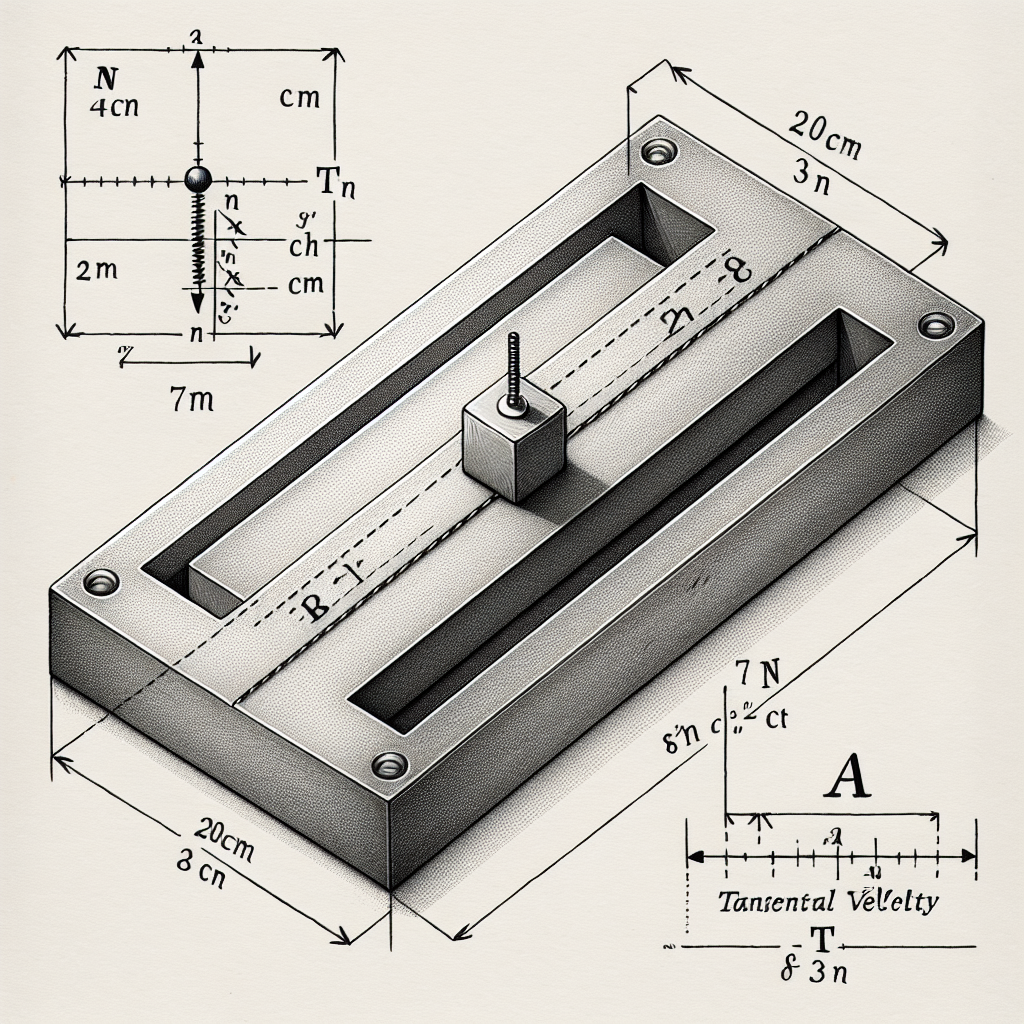
A metal plate has an axle through its center of mass. It is rectangular with l=20cm and h=8cm. It is 3cm thick. A force of 7N is applied to corner A. The force is applied constantly and in a direction that is always perpendicular to the AD surface. If the plate starts at rest, find the position of point A and its tangential velocity at t=2 seconds.
The correct answer and explanation is :
To solve this problem, we need to analyze the dynamics of a metal plate subjected to a force of (7 \, \text{N}) at point A, which is at the corner of the plate. The plate is initially at rest, and the force is applied perpendicularly to the surface at the corner, creating a torque that causes rotational motion around the center of mass.
Step 1: Identify Key Information
- Dimensions of the plate:
Length (l = 20 \, \text{cm} = 0.20 \, \text{m})
Height (h = 8 \, \text{cm} = 0.08 \, \text{m})
Thickness (t = 3 \, \text{cm} = 0.03 \, \text{m}) - Force applied: (F = 7 \, \text{N}) at corner A.
- Time duration: (t = 2 \, \text{seconds}).
- Plate is initially at rest.
Step 2: Calculate the Moment of Inertia
The moment of inertia (I) of a rectangular plate about an axis through its center of mass and perpendicular to the plane is given by:
[
I = \frac{1}{12} M (l^2 + h^2)
]
where (M) is the mass of the plate. To calculate the mass of the plate, we use the formula for the mass of a rectangular solid:
[
M = \rho \times V
]
where (\rho) is the density of the metal (we’ll assume it is constant and uniform), and (V) is the volume of the plate. The volume is:
[
V = l \times h \times t = 0.20 \times 0.08 \times 0.03 = 0.00048 \, \text{m}^3
]
Since the density of the material is not given, we assume it’s a standard material like steel with a density (\rho = 7800 \, \text{kg/m}^3). Thus, the mass of the plate is:
[
M = 7800 \times 0.00048 = 3.744 \, \text{kg}
]
Now we can calculate the moment of inertia:
[
I = \frac{1}{12} \times 3.744 \times (0.20^2 + 0.08^2) = \frac{1}{12} \times 3.744 \times (0.04 + 0.0064) = \frac{1}{12} \times 3.744 \times 0.0464 = 0.0145 \, \text{kg} \cdot \text{m}^2
]
Step 3: Calculate Torque and Angular Acceleration
The force applied at point A creates a torque (\tau) about the center of mass. The torque is given by:
[
\tau = F \times r
]
where (r) is the distance from the center of mass to point A. Since the plate is rectangular and the force is applied at the corner, (r) is the diagonal of the rectangle:
[
r = \sqrt{l^2 + h^2} = \sqrt{0.20^2 + 0.08^2} = \sqrt{0.04 + 0.0064} = \sqrt{0.0464} \approx 0.215 \, \text{m}
]
Thus, the torque is:
[
\tau = 7 \times 0.215 = 1.505 \, \text{N} \cdot \text{m}
]
Now, the angular acceleration (\alpha) is:
[
\alpha = \frac{\tau}{I} = \frac{1.505}{0.0145} \approx 103.45 \, \text{rad/s}^2
]
Step 4: Calculate Angular Velocity After 2 Seconds
Since the plate starts at rest, the angular velocity (\omega) after 2 seconds is:
[
\omega = \alpha \times t = 103.45 \times 2 = 206.9 \, \text{rad/s}
]
Step 5: Calculate Tangential Velocity of Point A
Finally, the tangential velocity (v_A) of point A is related to the angular velocity by:
[
v_A = \omega \times r = 206.9 \times 0.215 \approx 44.4 \, \text{m/s}
]
Final Answer
- Position of Point A: The position of point A remains fixed at the corner of the plate, which is at a distance (r = 0.215 \, \text{m}) from the center of mass.
- Tangential velocity of point A at (t = 2 \, \text{s}): (v_A \approx 44.4 \, \text{m/s}).
Explanation
In this problem, a constant force is applied at the corner of a rectangular plate. This force generates a torque about the center of mass, causing the plate to rotate. We calculate the moment of inertia, torque, and angular acceleration, and then use these values to find the angular velocity after 2 seconds. Using the angular velocity, we can find the tangential velocity at point A. The result shows that the plate rotates at a high speed, leading to a large tangential velocity at point A.