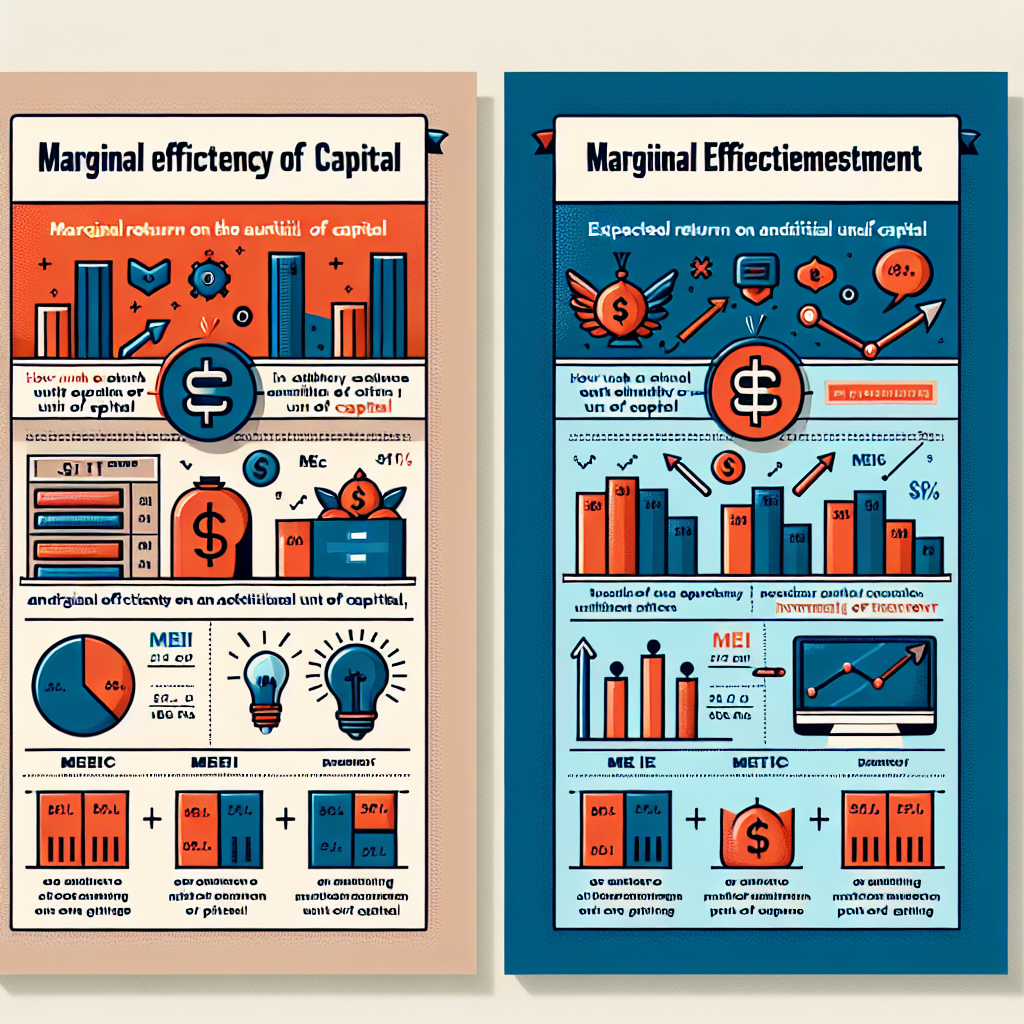
Distinguish between MEC and MEI.
MEC (Marginal Efficiency of Capital) and MEI (Marginal Efficiency of Investment) are two important concepts in economics that relate to investment decisions.
MEC: Refers to the expected return on an additional unit of capital. It indicates how much additional output or profit can be generated from investing in one more unit of capital.
MEI: Refers to the expected return on an additional unit of investment. It focuses on the profitability of investing in new projects or ventures.
In summary, while both MEC and MEI deal with returns on investment, MEC is more focused on capital, whereas MEI is concerned with the broader scope of investment opportunities.
The correct answer and explanation is :
Correct Answer:
MEC (Marginal Efficiency of Capital) refers to the expected rate of return on an additional unit of capital, typically fixed capital like machinery or equipment. It is used to evaluate how much output or income can be gained from investing in one more unit of capital.
MEI (Marginal Efficiency of Investment) refers to the expected rate of return on an additional unit of investment, considering all possible investment opportunities. It represents the profitability of new investments, including infrastructure, technology, human capital, or projects.
300-Word Explanation:
Marginal Efficiency of Capital (MEC) and Marginal Efficiency of Investment (MEI) are two crucial concepts in Keynesian economic theory, particularly in the context of investment decisions made by firms.
MEC is defined as the annual percentage return expected from an additional unit of capital. It measures how efficient a specific piece of capital equipment is in generating future returns. For example, if a company buys an extra machine, MEC calculates the rate of return from that machine over its useful life, considering both the initial cost and expected net returns. It focuses purely on physical capital and is derived from the productivity of capital assets.
In contrast, MEI extends the idea further by incorporating the entire range of investment opportunities, including intangible assets and broader project-based ventures. It represents how profitable the next unit of total investment expenditure is, taking into account factors such as technological innovation, business confidence, or market demand. MEI considers all forms of investments—not just capital goods—making it a more comprehensive measure.
A key distinction is that MEC is relatively static, based on current technology and market conditions, while MEI is more dynamic, influenced by expectations, economic policies, and shifts in investor sentiment.
In summary, MEC focuses narrowly on returns from capital goods, whereas MEI provides a wider lens on returns from overall investment activity. Policymakers and firms use MEI to assess where to allocate funds for growth, while MEC helps determine the efficiency of expanding the capital stock.