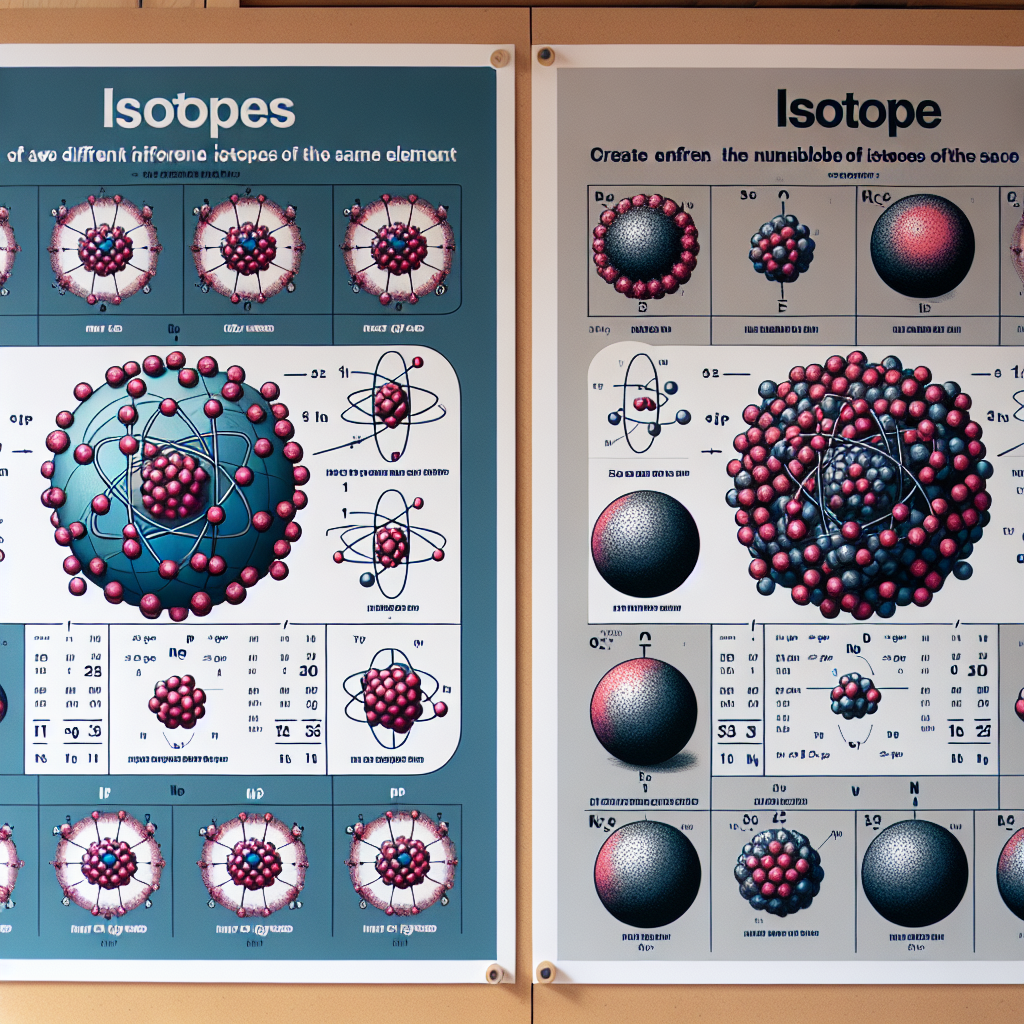
How are isotopes of the same element different from each other?
The correct answer and explanation is :
Correct Answer:
Isotopes of the same element differ in the number of neutrons in their atomic nuclei.
300-Word Explanation:
Isotopes are different forms of the same chemical element that have the same number of protons but a different number of neutrons in their atomic nuclei. Because the number of protons defines the element and determines its atomic number, all isotopes of an element share the same chemical identity. However, the variation in the number of neutrons causes a difference in atomic mass.
For example, carbon has several isotopes, but the most common ones are carbon-12 and carbon-14. Both have 6 protons, which makes them carbon, but carbon-12 has 6 neutrons, while carbon-14 has 8 neutrons. This difference in neutron number gives them different atomic masses—12 and 14 atomic mass units, respectively.
The presence of different numbers of neutrons can affect the stability of an atom. Some isotopes are stable, meaning they do not change or decay over time. Others are unstable or radioactive and will decay into other elements by emitting radiation. This is why isotopes play important roles in areas such as medicine, archaeology, and nuclear energy. For instance, carbon-14 is used in radiocarbon dating to determine the age of ancient artifacts.
Despite their difference in mass and stability, isotopes of the same element generally have the same chemical properties because chemical behavior is governed by electrons, which are determined by the number of protons. So, isotopes will form the same types of chemical bonds and participate in the same reactions, although differences in mass can slightly influence reaction rates or physical properties such as boiling and melting points.
In summary, isotopes differ in their neutron count, which affects their atomic mass and nuclear stability, but they share the same chemical properties due to having the same number of protons and electrons.