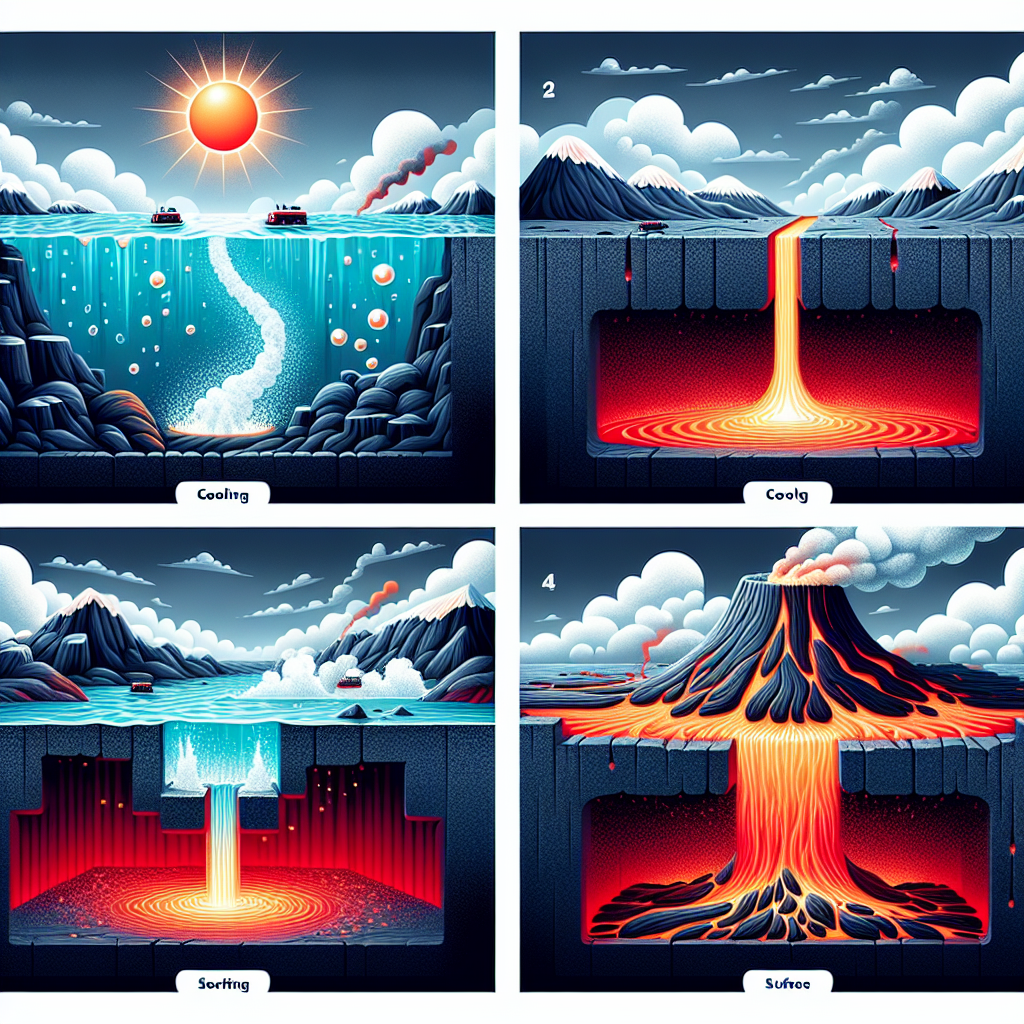
What does the texture of this rock indicate about its cooling history?
The magma cooled slowly and under water.
Slowly under relatively deep conditions.
Entirely at the surface.
For a while at some depth and then rose to the surface where it finished solidifying.
The correct answer and explanation is :
The correct answer is: For a while at some depth and then rose to the surface where it finished solidifying.
Explanation (Approx. 300 words):
The texture of an igneous rock tells us a great deal about its cooling history and the environment in which it solidified. One of the most telling textures is porphyritic texture, which is characterized by large crystals, known as phenocrysts, embedded in a finer-grained groundmass or matrix. This texture forms under two-stage cooling conditions.
In this type of cooling history, the magma initially cools slowly at depth, allowing some minerals to crystallize and grow to a visible size. These crystals become the phenocrysts. Later, the magma ascends toward or erupts at the surface, where the cooling rate increases dramatically. The remaining melt cools rapidly, forming the fine-grained or even glassy groundmass. This contrast in crystal sizes within a single rock reflects this two-part cooling process.
If the rock had cooled entirely at the surface, it would be completely fine-grained or glassy (aphanitic or volcanic glass), as seen in rocks like basalt or obsidian. Conversely, slow cooling under deep conditions would result in a coarse-grained texture (phaneritic), like that seen in granite, with uniformly large crystals. Cooling underwater could cause rapid quenching, forming a glassy texture or pillow lavas, but not the mixed textures observed in porphyritic rocks.
Therefore, the presence of both large and small crystals in a single rock sample indicates that the magma started cooling slowly beneath the Earth’s surface, giving time for the large crystals to form, and was then brought to the surface, possibly through volcanic eruption, where the remaining melt solidified quickly. This makes the correct interpretation: “For a while at some depth and then rose to the surface where it finished solidifying.”