Correctly label the components of the respiratory system.
Pleural cavity
Left main bronchus
Segmental bronchus
Diaphragm
Lobar bronchus
Right lung
Trachea
The correct answer and explanation is :
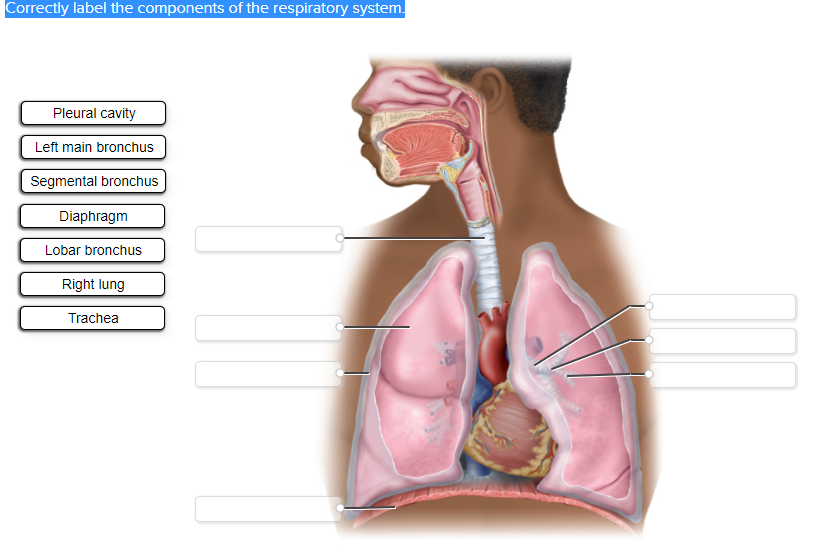
Here’s the correctly labeled respiratory system components for the image you provided:
- Trachea – This is the large airway that begins just below the larynx and travels down the neck into the thoracic cavity. It is the main passage for air to reach the lungs.
- Left Main Bronchus – Branches off the trachea and leads into the left lung, directing air specifically into that lung.
- Right Lung – The organ on the right side of the thoracic cavity responsible for gas exchange. It has three lobes: superior, middle, and inferior.
- Lobar Bronchus – These are secondary bronchi that branch from the main bronchi and lead into each lobe of the lungs. For example, the right lung has three lobar bronchi, one for each lobe.
- Segmental Bronchus – These are tertiary bronchi that branch off from the lobar bronchi, each serving a specific bronchopulmonary segment within the lung.
- Pleural Cavity – The thin fluid-filled space between the two layers of the pleura (visceral and parietal) surrounding each lung. It reduces friction and aids in lung expansion during breathing.
- Diaphragm – A dome-shaped muscle located below the lungs that contracts and flattens during inhalation, increasing thoracic volume and drawing air into the lungs.
Explanation (Approx. 300 words):
The respiratory system is responsible for the exchange of oxygen and carbon dioxide between the body and the environment. One of its main components is the trachea, a rigid tube supported by cartilage rings, which ensures an open airway. It bifurcates into the left and right main bronchi, each entering its respective lung.
Once inside the lungs, the main bronchi divide into lobar bronchi, also known as secondary bronchi, which supply the lobes of the lungs—three in the right lung and two in the left. The segmental bronchi, or tertiary bronchi, further subdivide within each lobe and direct air to smaller regions called bronchopulmonary segments.
The lungs are the principal organs where gas exchange occurs. The right lung has three lobes, making it larger than the left. Each lung is encased in a protective serous membrane called the pleura, and the pleural cavity between its layers is filled with fluid to reduce friction during respiration.
At the base of the lungs lies the diaphragm, a key respiratory muscle. Its contraction during inhalation expands the chest cavity and reduces intrathoracic pressure, drawing air into the lungs. During exhalation, the diaphragm relaxes and returns to its dome shape, pushing air out.
Each part of the respiratory system works in harmony to facilitate efficient air flow, protect the body from pathogens, and maintain acid-base balance through gas exchange.