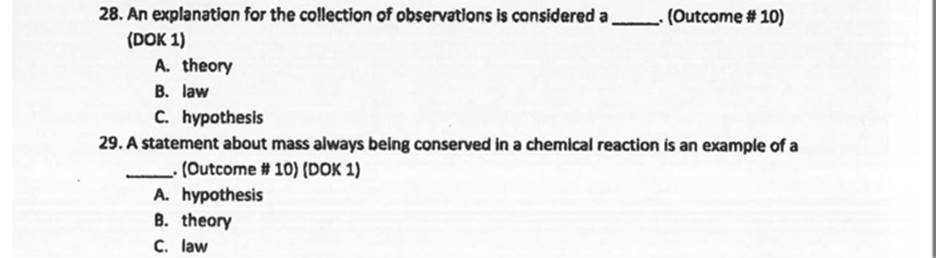
- An explanation for the collection of observations is considered a (Outcome # 10) (DOK 1) A. theory B. law C. hypothesis 29. A statement about mass always being conserved in a chemical reaction is an example of a ??·Outcome # 10) (DOK 1) A. hypothesis B. theory C. law
The Correct Answer and Explanation is:
Here are the correct answers to the questions in the image:
28. An explanation for the collection of observations is considered a:
A. theory
29. A statement about mass always being conserved in a chemical reaction is an example of a:
C. law
Explanation
In scientific inquiry, different terms such as hypothesis, theory, and law represent distinct stages and types of scientific knowledge.
A hypothesis is an initial, testable explanation or prediction about how something works. It is typically based on limited evidence and is meant to be tested through experimentation. Hypotheses can either be supported or refuted, but they are not considered as strong or well-established as theories or laws.
A theory is a comprehensive and well-substantiated explanation for a wide range of observations and experimental results. It has been repeatedly tested and confirmed through evidence and peer review. Theories explain why things happen. For instance, the Theory of Evolution explains how species change over time due to natural selection. Therefore, in Question 28, the correct answer is “theory” because theories are used to explain collections of observations.
A law, on the other hand, describes what always happens under certain conditions in nature. It does not explain why something happens but states that it does, based on repeated observations. Laws are concise and often expressed in mathematical terms. For example, the Law of Conservation of Mass states that mass is neither created nor destroyed in a chemical reaction—it remains constant. This law has been observed consistently in all chemical reactions. Thus, in Question 29, the correct answer is “law” because it refers to a consistent, universal statement about the conservation of mass.
In summary, scientific progress moves from hypotheses (initial ideas), to theories (well-supported explanations), and finally to laws (descriptive, consistent observations). Each has its own role in understanding the natural world.