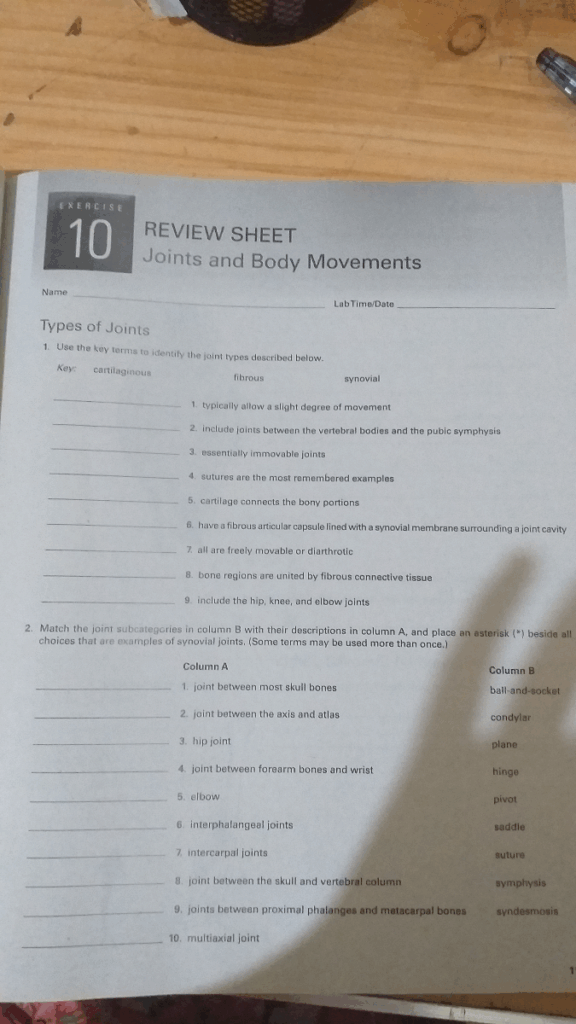
key terms to identify the joint types described below. Key: cartilaginous, fibrous 1. typically allow a slight degree of movement. 2. include joints between the vertebral bodies and the pubic symphysis. 3. essentially immovable joints. 4. sutures are the most remembered examples. 5. cartilage connects the bony portions. 6. have a fibrous articular capsule lined with a synovial membrane surrounding a joint cavity. 7. all are freely movable or diarthrotic. 8. bone regions are united by fibrous connective tissue. 9. include the hip, knee, and elbow joints. 2. Match the joint subcategories in column B with their descriptions in column A, and place an asterisk (*) beside all choices that are examples of synovial joints. (Some terms may be used more than once.) Column A 1. joint between most skull bones 2. joint between the axis and atlas 3. hip joint 4. joint between forearm bones and wrist 5. elbow 6. interphalangeal joints 7. intercarpal joints 8. joint between the skull and vertebral column 9. joints between proximal phalanges and metacarpal bones 10. multiaxial joint Column B ball-and-socket condylar plane hinge pivot saddle suture symphysis syndesmosis
The Correct Answer and Explanation is:
Here are the correct answers for the worksheet:
Part 1: Types of Joints
Key: Cartilaginous, Fibrous, Synovial
- Cartilaginous – typically allow a slight degree of movement.
- Cartilaginous – include joints between the vertebral bodies and the pubic symphysis.
- Fibrous – essentially immovable joints.
- Fibrous – sutures are the most remembered examples.
- Cartilaginous – cartilage connects the bony portions.
- Synovial – have a fibrous articular capsule lined with a synovial membrane surrounding a joint cavity.
- Synovial – all are freely movable or diarthrotic.
- Fibrous – bone regions are united by fibrous connective tissue.
- Synovial – include the hip, knee, and elbow joints.
Part 2: Match the joint subcategories
| Column A Description | Column B Answer | Synovial (*) |
|---|---|---|
| 1. joint between most skull bones | Suture | |
| 2. joint between the axis and atlas | Pivot | * |
| 3. hip joint | Ball-and-socket | * |
| 4. joint between forearm bones and wrist | Condylar | * |
| 5. elbow | Hinge | * |
| 6. interphalangeal joints | Hinge | * |
| 7. intercarpal joints | Plane | * |
| 8. joint between the skull and vertebral column | Condylar | * |
| 9. joints between proximal phalanges and metacarpal bones | Condylar | * |
| 10. multiaxial joint | Ball-and-socket | * |
Explanation
Joints, also called articulations, are connections between bones that allow for varying degrees of movement. They are structurally classified into three types: fibrous, cartilaginous, and synovial. Fibrous joints are generally immovable (e.g., sutures in the skull) and consist of bones joined by dense connective tissue. These joints are primarily found in areas where strength and stability are more important than movement.
Cartilaginous joints, such as those found in the spine (intervertebral discs) and pubic symphysis, allow slight movement and are connected by cartilage. They serve to absorb shock and provide flexibility in certain parts of the body.
Synovial joints are the most common and functionally versatile, permitting free movement. These joints have a synovial cavity filled with fluid and are surrounded by a fibrous capsule. They include subtypes such as ball-and-socket (e.g., shoulder, hip), hinge (e.g., elbow, knee), pivot (e.g., between atlas and axis), and condylar joints (e.g., wrist and metacarpophalangeal joints).
The matching activity reinforces how structure relates to function in joints. For instance, the hip and shoulder joints are ball-and-socket types, providing a wide range of motion. In contrast, hinge joints like the elbow and interphalangeal joints permit movement in one plane, similar to a door hinge. Understanding these distinctions is crucial in fields like anatomy, physical therapy, and sports science, where joint structure and mobility significantly affect movement and injury prevention.