Discuss briefly a comparison of the two vineyard or for an analysis of a single vinegar, calculate the standard deviation and the relative standard deviation. DATA ANALYSIS C AND D
The Correct Answer and Explanation is:
Data Analysis C & D: Vinegar Analysis
Comparison of Two Trials
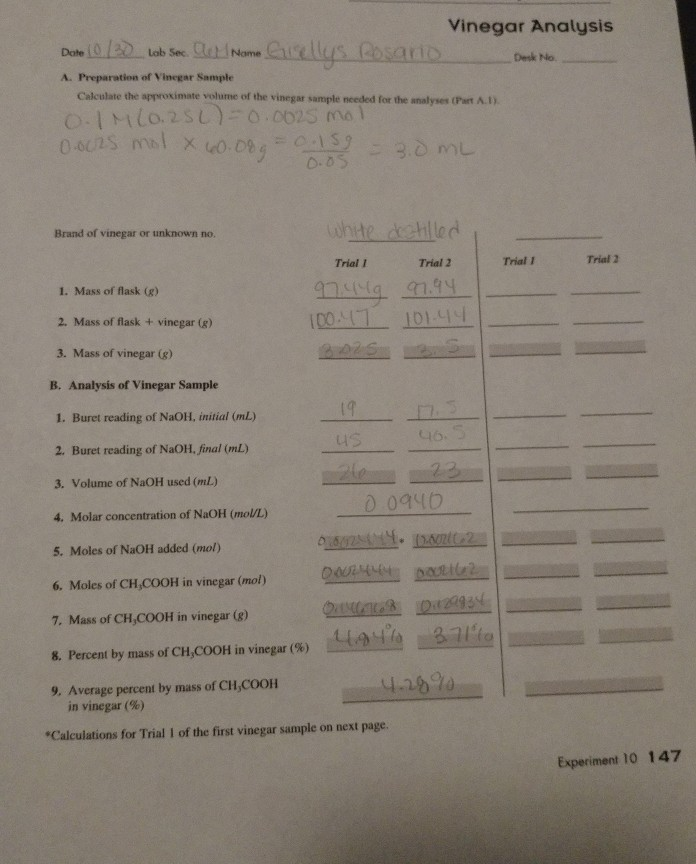
The experiment involved analyzing the acetic acid content in a sample of white distilled vinegar using titration with NaOH. Two trials were conducted, with the following results:
- Trial 1: 4.29% CH₃COOH by mass
- Trial 2: 3.71% CH₃COOH by mass
Although both trials test the same vinegar type, the percent by mass differs slightly. Trial 1 shows a higher percentage of acetic acid. Variability in titration technique, measurement precision (especially buret readings), or slight differences in sample mass could contribute to this difference.
Standard Deviation (SD) and Relative Standard Deviation (RSD)
To calculate standard deviation and RSD:
Given values:
- Trial 1: 4.29%
- Trial 2: 3.71%
Step 1: Mean (Average) Mean=4.29+3.712=8.002=4.00%\text{Mean} = \frac{4.29 + 3.71}{2} = \frac{8.00}{2} = 4.00\%
Step 2: Standard Deviation (SD) SD=(4.29−4.00)2+(3.71−4.00)22−1=(0.29)2+(−0.29)21=0.1682≈0.41SD = \sqrt{\frac{(4.29 – 4.00)^2 + (3.71 – 4.00)^2}{2 – 1}} = \sqrt{\frac{(0.29)^2 + (-0.29)^2}{1}} = \sqrt{0.1682} \approx 0.41
Step 3: Relative Standard Deviation (RSD) RSD=(SDMean)×100=(0.414.00)×100≈10.25%RSD = \left( \frac{SD}{\text{Mean}} \right) \times 100 = \left( \frac{0.41}{4.00} \right) \times 100 \approx 10.25\%
Explanation and Interpretation
In this vinegar titration experiment, two trials were performed to determine the acetic acid content of white distilled vinegar. The percent by mass of acetic acid in each trial was 4.29% and 3.71%. These values are reasonably close, indicating consistent but not perfectly precise experimental technique.
To evaluate the reliability of the results, we calculated the standard deviation and relative standard deviation. The standard deviation (SD) is a measure of how much the individual results deviate from the mean. We obtained an SD of approximately 0.41%. This means the two results differ from the average (4.00%) by about 0.41% on average.
The relative standard deviation (RSD), which expresses the SD as a percentage of the mean, was 10.25%. In analytical chemistry, an RSD under 5% is typically considered excellent, while values between 5–15% are acceptable for student lab work. An RSD of 10.25% suggests moderate precision—reasonable for a manual titration experiment performed by students.
Possible sources of error include slight inaccuracies in reading the buret, inconsistent swirling of the sample during titration, or slightly different amounts of vinegar mass used. Improving these aspects could lower the variability and yield more consistent results.
In summary, the experiment produced results within an acceptable range. While there’s some variability between trials, the average acetic acid content (4.00%) aligns well with the expected range for white distilled vinegar, which is typically 4–5%. The standard deviation and RSD calculations help quantify the precision and reliability of the experiment.