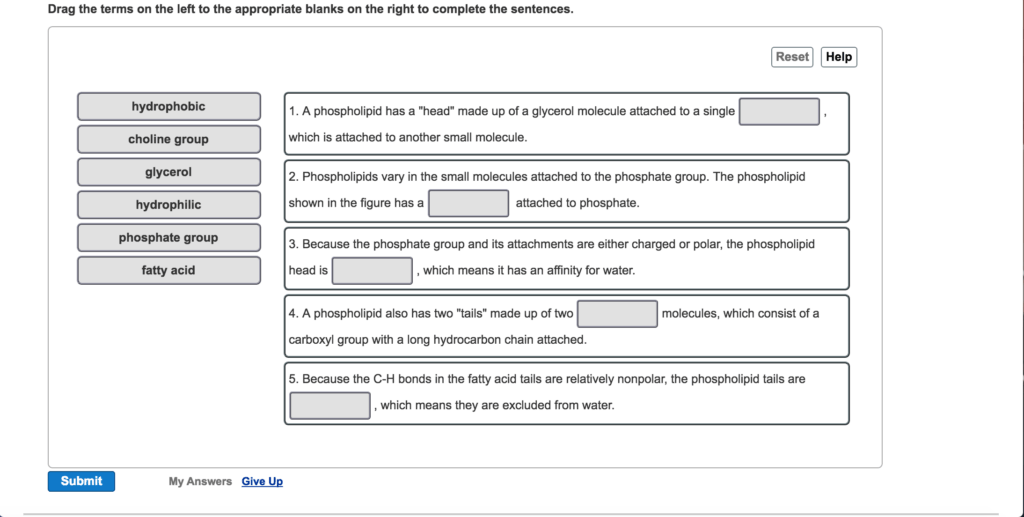
Drag the terms on the left to the appropriate blanks on the right to complete the sentences. A phospholipid has a “head” made up of a glycerol molecule attached to a single, which is attached to another small molecule. Phospholipids vary in the small molecules attached to the phosphate group. The phospholipid shown in the figure has a attached to phosphate. Because the phosphate group and its attachments are either charged or polar, the phospholipid head is, which means it has an affinity for water. A phospholipid also has two “tails” made up of two molecules, which consist of a carboxyl group with a long hydrocarbon chain attached. Because the C – H bonds in the fatty acid tails are relatively nonpolar, the phospholipid tails are, which means they are excluded from water.
The Correct Answer and Explanation is:
Here are the correct terms placed in the blanks:
- A phospholipid has a “head” made up of a glycerol molecule attached to a single phosphate group, which is attached to another small molecule.
- Phospholipids vary in the small molecules attached to the phosphate group. The phospholipid shown in the figure has a choline group attached to phosphate.
- Because the phosphate group and its attachments are either charged or polar, the phospholipid head is hydrophilic, which means it has an affinity for water.
- A phospholipid also has two “tails” made up of two fatty acid molecules, which consist of a carboxyl group with a long hydrocarbon chain attached.
- Because the C-H bonds in the fatty acid tails are relatively nonpolar, the phospholipid tails are hydrophobic, which means they are excluded from water.
Explanation
Phospholipids are essential components of cell membranes, forming the structural basis of the lipid bilayer. Their unique chemical structure enables them to perform this role effectively.
A phospholipid molecule consists of two main parts: a hydrophilic “head” and two hydrophobic “tails.” The head is composed of a glycerol backbone bonded to a phosphate group, which in turn is attached to a small molecule such as choline. The presence of the negatively charged phosphate group and other polar attachments makes the head hydrophilic, meaning it has an affinity for water and can form hydrogen bonds with water molecules.
The two tails of the phospholipid are made up of fatty acid chains. These chains are long hydrocarbon structures that are nonpolar due to their abundance of carbon-hydrogen (C-H) bonds. Because they do not interact favorably with water, they are hydrophobic, meaning they repel water.
This amphipathic nature (having both hydrophilic and hydrophobic regions) allows phospholipids to spontaneously form bilayers in aqueous environments. In a bilayer, the hydrophilic heads face outward toward the water, while the hydrophobic tails are sequestered inside, away from water. This arrangement creates a semi-permeable membrane that is critical for controlling the passage of substances into and out of cells.
In summary, the phospholipid’s structure—specifically, the phosphate head group and fatty acid tails—underpins its role in membrane formation and cellular function. Understanding these components helps explain the molecular basis of biological membranes and their dynamic behavior in cells.