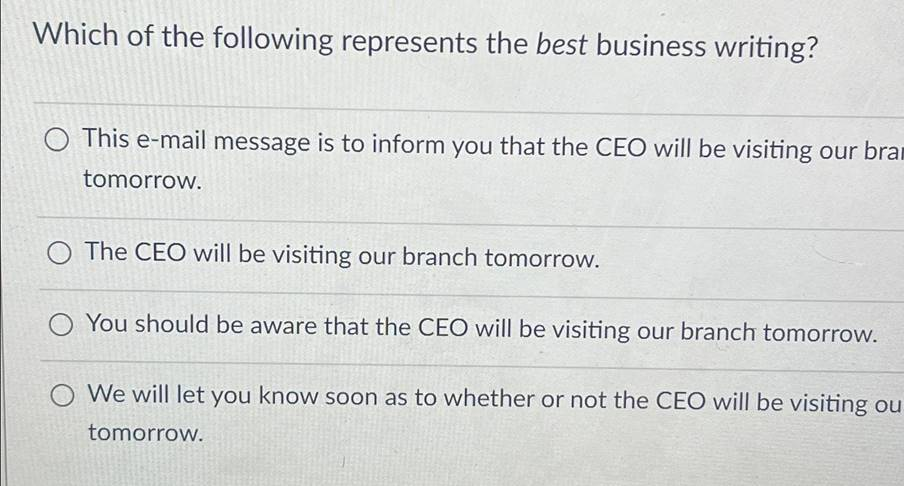
Which of the following represents the best business writing?
This e-mail message is to inform you that the CEO will be visiting our branch tomorrow.
The CEO will be visiting our branch tomorrow.
You should be aware that the CEO will be visiting our branch tomorrow.
We will let you know soon as to whether or not the CEO will be visiting our branch tomorrow.
The Correct Answer and Explanation is:
The correct answer is:
“The CEO will be visiting our branch tomorrow.”
Explanation
In business writing, clarity, conciseness, and professionalism are paramount. Among the given choices, “The CEO will be visiting our branch tomorrow” best exemplifies effective business writing because it is clear, direct, and concise.
1. Clarity and Directness:
This sentence communicates the essential information — the CEO’s visit — without unnecessary introductory phrases or filler words. The reader immediately understands the key message.
2. Conciseness:
Business communication should avoid wordiness. Other options, like “This e-mail message is to inform you that…” or “You should be aware that…”, are unnecessarily verbose. Such phrases add no value and can make messages longer and harder to scan quickly.
3. Tone and Professionalism:
The selected sentence maintains a professional tone without being overly formal or casual. It strikes the right balance for workplace communication. In contrast, “We will let you know soon as to whether or not…” introduces uncertainty and is awkwardly phrased, weakening the impact of the message.
4. Reader-Centered Writing:
Effective business writing is typically reader-focused, meaning it considers the needs and time of the reader. The chosen sentence respects the reader’s time by getting straight to the point.
Comparison to Other Options:
- “This e-mail message is to inform you…” is redundant — the reader knows they are reading a message.
- “You should be aware that…” sounds patronizing and formal in an outdated way.
- “We will let you know soon as to whether or not…” is unclear and passive, delaying the actual message.
In summary, concise and clear communication fosters efficiency and professionalism in the business environment. “The CEO will be visiting our branch tomorrow” fulfills these criteria best and thus represents the best business writing among the options.