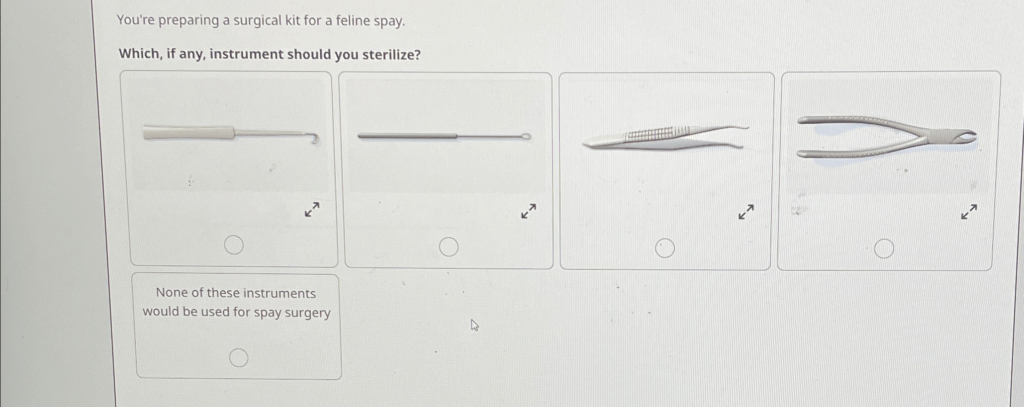
You’re preparing a surgical kit for a feline spay. Which, if any, instrument should you sterilize? None of these instruments would be used for spay surgery.
The Correct Answer and Explanation is:
The correct answer is: None of these instruments would be used for spay surgery.
Explanation
When preparing a surgical kit for a feline spay (ovariohysterectomy), it’s critical to ensure that all the instruments involved in the procedure are sterilized and appropriate for the surgery. A feline spay requires specific surgical tools such as a scalpel, needle holders, tissue forceps, hemostats (e.g., Kelly or Crile), scissors (like Metzenbaum or Mayo), and spay hooks.
Let’s evaluate the instruments shown in the image:
- First Instrument (Left to Right): Appears to be a dental explorer or probe, commonly used in dental exams—not surgical procedures like a spay.
- Second Instrument: Looks like a lacrimal duct cannula or ear loop used in ophthalmic or ear procedures—not suitable for spay surgery.
- Third Instrument: This resembles Adson or dressing forceps, used for holding dressings or delicate tissue. While forceps are used in surgery, this specific type isn’t typically used for a spay.
- Fourth Instrument: Appears to be a dental extraction forceps or nail clippers, typically used in dentistry or nail trims, not abdominal surgery.
A spay surgery involves making an incision into the abdomen, locating the reproductive organs, ligating blood vessels, and removing the ovaries and uterus. This requires instruments specifically designed for soft tissue dissection and suturing. None of the instruments in the image are appropriate for that purpose, and their use would be both impractical and unsafe.
Thus, sterilizing any of these instruments for a feline spay would be unnecessary and incorrect. The correct approach is to use a standard sterile surgical pack with appropriate instruments designed for general soft tissue surgery, particularly abdominal procedures. Always follow veterinary surgical standards for instrument selection and sterilization to ensure patient safety and surgical success.