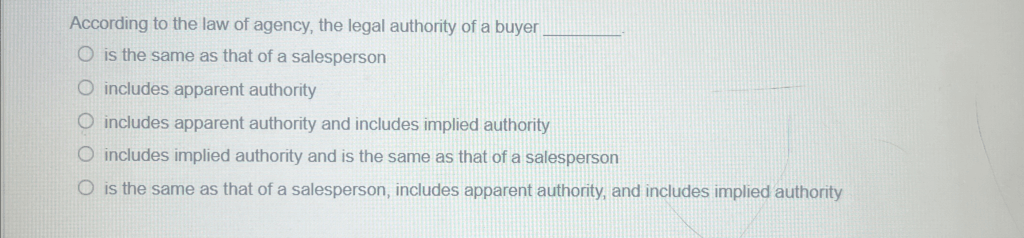
According to the law of agency, the legal authority of a buyer is the same as that of a salesperson, includes apparent authority, and includes implied authority.
The Correct Answer and Explanation is:
Correct Answer:
○ is the same as that of a salesperson, includes apparent authority, and includes implied authority
Explanation
According to the law of agency, a buyer acting as an agent for a principal (such as an employer or organization) has legal authority that mirrors several forms of authority typically granted to salespersons. This includes actual, apparent, and implied authority.
- Actual Authority: This is the express permission given to the agent (buyer or salesperson) by the principal, either verbally or in writing. For example, if an employer authorizes a buyer to purchase inventory up to a certain amount, this is actual authority.
- Implied Authority: This type of authority is not directly expressed but is reasonably necessary to carry out the agent’s duties. For instance, if a buyer is authorized to purchase goods, it is implied that they can negotiate prices, arrange transportation, or sign related contracts — even if these actions are not explicitly stated.
- Apparent Authority: This arises when a third party reasonably believes the agent has authority, based on the principal’s representations. For example, if a company gives a buyer a business card and introduces them as someone who handles purchasing, vendors can reasonably assume the buyer has the authority to make purchasing decisions, even if the buyer’s actual authority is more limited.
Because both buyers and salespersons function as agents in commercial transactions, they operate under similar agency laws. Therefore, the legal authority granted to a buyer is equivalent to that of a salesperson and includes both apparent and implied authority.
Understanding these distinctions helps ensure that businesses remain legally protected and that agents do not unintentionally overstep their authority. When an agent operates within their authority, contracts and decisions they make are binding on the principal. If they exceed their authority, the principal may not be held liable unless apparent authority is established.