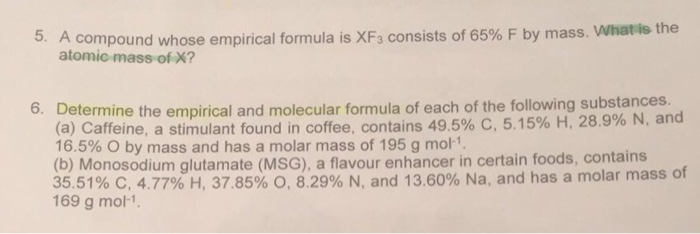
What is the 5. A compound whose empirical formula is XF3 consists of 65% F by mass. atomic mass of X?:
- (a) Caffeine, a stimulant found in coffee, contains 49.5% C, 5.15% H, 28.9% N, and 16.5% O by mass and has a molar mass of 195 g mol-1
- (b) Monosodium glutamate (MSG), a flavour enhancer in certain foods, contains 35.51% C, 4.77% H, 37.85% O, 8.29% N, and 13.60% Na, and has a molar mass of 169 g mol
The Correct Answer and Explanation is:
Question 5 Answer:
We are told the empirical formula is XF₃ and the compound is 65% fluorine by mass. Let’s find the atomic mass of element X.
Let:
- Mass of 1 mole of XF₃ = M
- Mass of 3 fluorine atoms = 3 × 19.0 = 57.0 g
- Since fluorine makes up 65% of the compound by mass:
57.0M=0.65⇒M=57.00.65=87.69 g/mol\frac{57.0}{M} = 0.65 \Rightarrow M = \frac{57.0}{0.65} = 87.69 \, \text{g/mol}
Atomic mass of X ≈ 87.7 g/mol
Question 6(a): Caffeine
Given:
- C = 49.5%, H = 5.15%, N = 28.9%, O = 16.5%
- Molar mass = 195 g/mol
Assume 100 g of caffeine:
- C: 49.5 g → 49.5 / 12.01 = 4.12 mol
- H: 5.15 g → 5.15 / 1.008 = 5.11 mol
- N: 28.9 g → 28.9 / 14.01 = 2.06 mol
- O: 16.5 g → 16.5 / 16.00 = 1.03 mol
Divide all by the smallest (1.03):
- C: 4.12 / 1.03 ≈ 4
- H: 5.11 / 1.03 ≈ 5
- N: 2.06 / 1.03 ≈ 2
- O: 1.03 / 1.03 = 1
Empirical formula = C₄H₅N₂O
Empirical mass = (4×12.01) + (5×1.008) + (2×14.01) + (1×16.00) = 97.1 g/mol
195 / 97.1 ≈ 2 → Multiply subscripts by 2
Molecular formula = C₈H₁₀N₄O₂
Question 6(b): MSG
Given:
- C = 35.51%, H = 4.77%, O = 37.85%, N = 8.29%, Na = 13.60%
- Molar mass = 169 g/mol
Assume 100 g of MSG:
- C: 35.51 g → 2.96 mol
- H: 4.77 g → 4.73 mol
- O: 37.85 g → 2.37 mol
- N: 8.29 g → 0.592 mol
- Na: 13.60 g → 0.592 mol
Divide all by 0.592:
- C: 2.96 / 0.592 ≈ 5
- H: 4.73 / 0.592 ≈ 8
- O: 2.37 / 0.592 ≈ 4
- N: 0.592 / 0.592 = 1
- Na: 0.592 / 0.592 = 1
Empirical formula = C₅H₈NO₄Na
Empirical mass = 169 g/mol
Molecular formula = C₅H₈NO₄Na (same as empirical)
Summary:
- Q5 Answer: Atomic mass of X ≈ 87.7 g/mol
- Q6(a): Empirical = C₄H₅N₂O, Molecular = C₈H₁₀N₄O₂
- Q6(b): Empirical & Molecular = C₅H₈NO₄Na
This analysis uses percent-by-mass conversions to moles and ratio simplifications to find empirical formulas. For molecular formulas, the molar mass confirms the multiplier of empirical units.