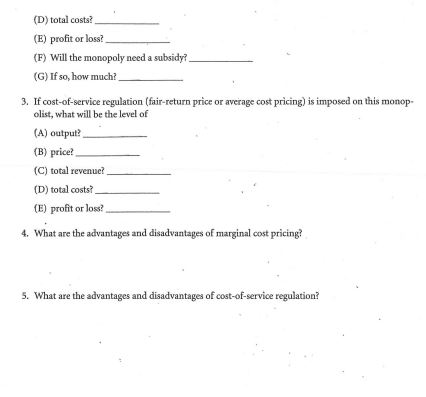
If cost-of-service regulation (fair-return price or average cost pricing) is imposed on this monopolist, what will be the level of (A) output? (B) price? (C) total revenue? (D) total costs? (E) profit or loss? (F) Will the monopoly need a subsidy? (G) If so, how much? 4. What are the advantages and disadvantages of marginal cost pricing? 5. What are the advantages and disadvantages of cost-of-service regulation?
The Correct Answer and Explanation is:
To answer the questions provided in the image, we need to understand the concepts of cost-of-service regulation, marginal cost pricing, and their implications for monopolies.
3. If cost-of-service regulation (fair-return price or average cost pricing) is imposed on this monopolist:
Assuming a typical natural monopoly (like a utility), the outcomes are:
- (A) Output?
Higher than monopoly output, but less than socially optimal level. - (B) Price?
Equal to average total cost (ATC). - (C) Total Revenue?
Price × Output → Since price = ATC, revenue covers all costs. - (D) Total Costs?
Equal to total revenue → Because price = ATC. - (E) Profit or Loss?
Zero economic profit → Normal accounting profit. - (F) Will the monopoly need a subsidy?
No, because revenue covers total costs. - (G) If so, how much?
$0, since no subsidy is needed.
4. Advantages and Disadvantages of Marginal Cost Pricing
Advantages:
- Leads to allocative efficiency: price equals marginal cost (P = MC), maximizing social welfare.
- Consumers benefit from lower prices and increased output compared to monopoly pricing.
- Reduces deadweight loss caused by monopoly power.
Disadvantages:
- In natural monopolies, MC < ATC, so pricing at MC causes losses.
- The firm may require government subsidies to stay in business.
- Difficult to measure marginal cost accurately, especially in dynamic industries.
5. Advantages and Disadvantages of Cost-of-Service Regulation
Advantages:
- Ensures the monopolist recovers its costs, including a normal return on capital.
- Prevents excessive pricing while keeping firms financially viable.
- Encourages stable service in essential industries (e.g., electricity, water).
Disadvantages:
- Lacks incentive for cost minimization: firms may inflate costs to justify higher prices (“gold-plating”).
- May lead to inefficiencies and reduced innovation due to guaranteed profit.
- Regulatory process can be bureaucratic and slow, limiting responsiveness to market changes.
Explanation:
In monopoly markets, especially natural monopolies, regulation is often needed to balance public interest and firm sustainability. Under cost-of-service regulation (average cost pricing), the government sets prices so that the firm covers all costs, including a fair return on capital. This results in zero economic profit but ensures the firm continues operating without requiring a subsidy. Output under such regulation is higher than the monopoly level (where MR = MC) but not as high as under marginal cost pricing. Consumers benefit from lower prices, and the firm maintains viability.
Marginal cost pricing, on the other hand, sets prices equal to the cost of producing one more unit. This is economically efficient as it maximizes total welfare and eliminates deadweight loss. However, in industries with declining average costs (e.g., utilities), marginal cost pricing often results in losses because the price is below average cost. Thus, the firm would need a subsidy to operate, which may not be politically or financially feasible.
Cost-of-service regulation avoids this issue by allowing the firm to break even. Yet, it has its drawbacks. Since firms are guaranteed a return, they lack incentive to cut costs or innovate. This can lead to inefficient spending and inflated capital bases—a phenomenon known as “gold-plating.” Furthermore, the regulatory process can be cumbersome and may lag behind industry changes.
In conclusion, marginal cost pricing is ideal for efficiency but often impractical due to financial sustainability. Cost-of-service regulation provides a workable compromise, ensuring service provision without market abuse, though at the cost of some inefficiency. Choosing the right approach depends on the industry’s characteristics and public policy goals.