Please tell me the polynomials and why are they polynomials. Thank you for your time.
Which of the following are polynomial functions?
f(x) = 0
f(x) = -9
f(x) = 3 + 1
f(x) = 1/2 + 8
f(x) = 32 + 2
f(x) = 45/84
Check work
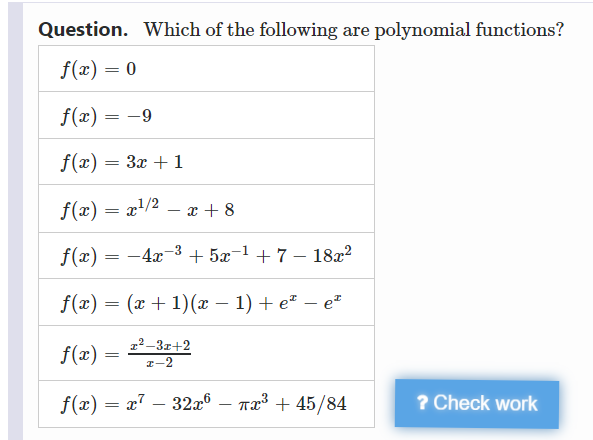
The Correct Answer and Explanation is:
A polynomial function is a function of the form:
f(x)=anxn+an−1xn−1+⋯+a1x+a0f(x) = a_nx^n + a_{n-1}x^{n-1} + \dots + a_1x + a_0
Where:
- All exponents of xx are whole numbers (0, 1, 2, 3,…)
- All coefficients aia_i are real numbers
- No negative or fractional exponents
- No variables in denominators or under roots
✅ Polynomial Functions:
- f(x)=0f(x) = 0
- This is the zero polynomial. All coefficients are zero, and it is valid.
- ✅ Polynomial
- f(x)=−9f(x) = -9
- Constant function, degree 0.
- ✅ Polynomial
- f(x)=3x+1f(x) = 3x + 1
- Degree 1 polynomial.
- ✅ Polynomial
- f(x)=x7−32×6−πx3+4584f(x) = x^7 – 32x^6 – \pi x^3 + \frac{45}{84}
- All exponents are whole numbers; constants (like π\pi and fractions) are allowed as coefficients.
- ✅ Polynomial
❌ Not Polynomial Functions:
- f(x)=x1/2−x+8f(x) = x^{1/2} – x + 8
- Contains a fractional exponent x1/2x^{1/2} → not allowed.
- ❌ Not a polynomial
- f(x)=−4x−3+5x−1+7−18x2f(x) = -4x^{-3} + 5x^{-1} + 7 – 18x^2
- Contains negative exponents → not a polynomial.
- ❌ Not a polynomial
- f(x)=(x+1)(x−1)+ex−exf(x) = (x+1)(x-1) + e^x – e^x
- ex−ex=0e^x – e^x = 0, so it simplifies to (x+1)(x−1)=x2−1(x+1)(x-1) = x^2 – 1 → Polynomial.
- ✅ Polynomial
- f(x)=x2−3x+2x−2f(x) = \frac{x^2 – 3x + 2}{x – 2}
- This is a rational function, division by a variable expression → not a polynomial
- ❌ Not a polynomial
✅ Final Answer (Polynomial functions):
- f(x)=0f(x) = 0
- f(x)=−9f(x) = -9
- f(x)=3x+1f(x) = 3x + 1
- f(x)=(x+1)(x−1)+ex−exf(x) = (x+1)(x-1) + e^x – e^x
- f(x)=x7−32×6−πx3+4584f(x) = x^7 – 32x^6 – \pi x^3 + \frac{45}{84}
Explanation (300 words):
Polynomial functions are algebraic expressions consisting of variables and constants combined using only addition, subtraction, multiplication, and non-negative whole number exponents. They are defined over all real numbers and do not involve operations such as division by variables, roots (like square roots), or exponential functions like exe^x.
To determine whether a function is a polynomial, we examine the powers of the variable and the nature of the coefficients. A polynomial must not include variables in the denominator (which creates a rational function), fractional or negative exponents (which imply roots or reciprocals), or transcendental functions like exponentials or logarithms.
In the image, the functions f(x)=0f(x) = 0, f(x)=−9f(x) = -9, and f(x)=3x+1f(x) = 3x + 1 are straightforward polynomials of degree 0 or 1. The function f(x)=(x+1)(x−1)+ex−exf(x) = (x+1)(x-1) + e^x – e^x simplifies to x2−1x^2 – 1 after canceling the exponential terms, which is a valid polynomial. The last function f(x)=x7−32×6−πx3+4584f(x) = x^7 – 32x^6 – \pi x^3 + \frac{45}{84} is also a polynomial, even though it includes irrational (π\pi) and fractional coefficients, since these are allowed in polynomials.
However, functions like x1/2−x+8x^{1/2} – x + 8 and −4x−3+5x−1+7−18×2-4x^{-3} + 5x^{-1} + 7 – 18x^2 are not polynomials due to fractional and negative exponents, respectively. Likewise, x2−3x+2x−2\frac{x^2 – 3x + 2}{x – 2} is a rational function because it involves division by a variable expression.
Thus, identifying polynomials hinges on recognizing proper structure and allowable operations.