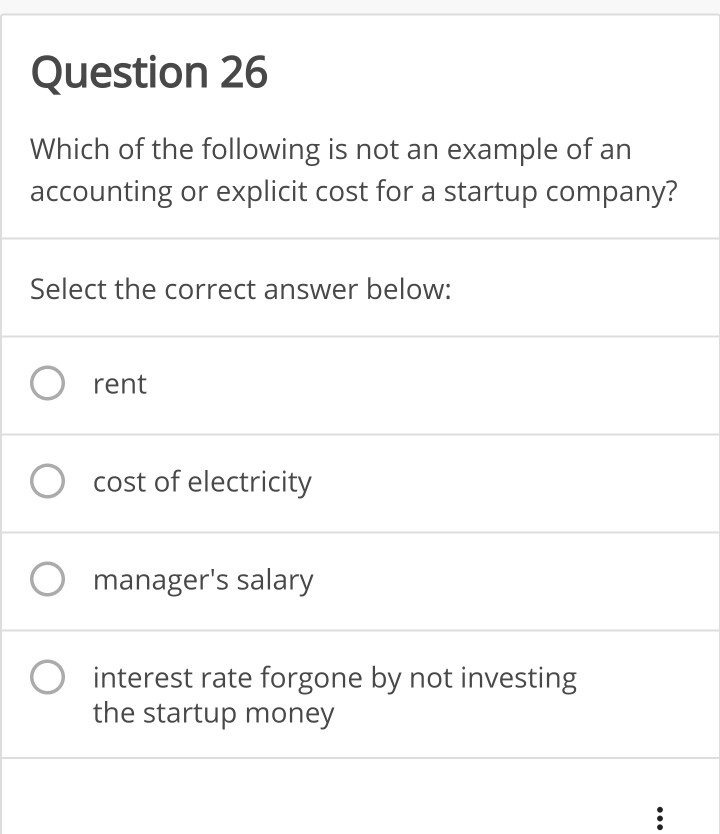
Question 26 Which of the following is not an example of an accounting or explicit cost for a startup company? Select the correct answer below:
rent
cost of electricity
manager’s salary
interest rate forgone by not investing the startup money
The Correct Answer and Explanation is:
Correct Answer:
interest rate forgone by not investing the startup money
Explanation
In accounting and economics, costs are classified into explicit costs and implicit costs. Understanding the difference is critical for startup companies when evaluating their financial performance.
Explicit costs, also known as accounting costs, are actual out-of-pocket expenses that a business incurs and records in its financial statements. These include payments for rent, utilities, salaries, raw materials, and other operating expenses. They are tangible and directly impact the firm’s cash flow.
Let’s analyze the options:
- Rent: This is a classic example of an explicit cost. A startup typically pays rent for office or operational space, and this payment is recorded in the accounting books.
- Cost of electricity: This is also an explicit cost. Electricity usage is billed monthly, and the company pays for it directly.
- Manager’s salary: Wages and salaries are among the most common explicit costs. They are contractual payments made to employees and are accounted for in financial reports.
Now consider the fourth option:
- Interest rate forgone by not investing the startup money: This refers to an opportunity cost, which is a type of implicit cost. It represents the earnings that could have been generated if the money invested in the business had instead been placed in an interest-bearing investment. Implicit costs do not involve direct payments and are not recorded in financial accounting. They are used in economic profit calculations, not accounting profit.
Hence, the interest rate forgone is not an accounting or explicit cost. It is an implicit cost, which represents the opportunity cost of using the owner’s resources (e.g., capital, time) in the business instead of elsewhere.
Therefore, the correct answer is:
interest rate forgone by not investing the startup money.