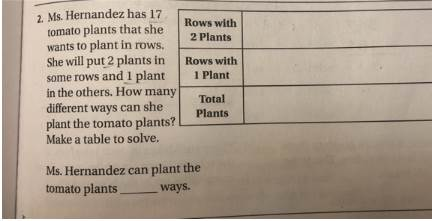
Mos. Hernandez has 17 tomato plants that she wants to plant in rows. She will put 2 plants in some rows and 1 plant in the others.
The Correct Answer and Explanation is:
To solve this problem, we need to determine how many different combinations of rows with 2 plants and rows with 1 plant will total 17 tomato plants.
Let’s define:
- Let xx be the number of rows with 2 plants.
- Let yy be the number of rows with 1 plant.
We are told the total number of tomato plants is 17, so: 2x+y=172x + y = 17
We are looking for whole number (integer) solutions to this equation where x≥0x \geq 0 and y≥0y \geq 0.
Let’s make a table:
| Rows with 2 Plants (x) | Rows with 1 Plant (y) | Total Plants (2x + y) |
|---|---|---|
| 0 | 17 | 0 + 17 = 17 |
| 1 | 15 | 2 + 15 = 17 |
| 2 | 13 | 4 + 13 = 17 |
| 3 | 11 | 6 + 11 = 17 |
| 4 | 9 | 8 + 9 = 17 |
| 5 | 7 | 10 + 7 = 17 |
| 6 | 5 | 12 + 5 = 17 |
| 7 | 3 | 14 + 3 = 17 |
| 8 | 1 | 16 + 1 = 17 |
Once x=9x = 9, 2x=182x = 18, which exceeds 17, so we stop.
Final Answer:
There are 9 different ways Ms. Hernandez can plant the tomato plants.
Explanation
To find the number of different ways Ms. Hernandez can plant her 17 tomato plants, we use a problem-solving strategy involving algebra and tables. She has the option to plant either 2 tomato plants per row or 1 tomato plant per row. The goal is to determine how many combinations of rows with 2 plants and rows with 1 plant will total exactly 17 plants.
We start by letting variables represent each type of row. Let xx represent the number of rows with 2 plants, and yy represent the number of rows with 1 plant. The total number of tomato plants is then given by the equation 2x+y=172x + y = 17.
We are interested only in non-negative integers for xx and yy because we can’t have a negative number of rows. So, we try different values for xx starting from 0 and solve for yy each time using the equation y=17−2xy = 17 – 2x. We keep increasing xx until 2x2x exceeds 17.
We find that there are 9 valid combinations that satisfy the equation: (0,17), (1,15), (2,13), …, (8,1). Each combination represents a different way to plant the tomato plants. Thus, Ms. Hernandez has 9 different planting options.
This approach not only gives the answer but also shows the logical reasoning and mathematical tools (algebra and systematic listing) used to solve the problem. It helps build problem-solving skills in pattern recognition and working with constraints.