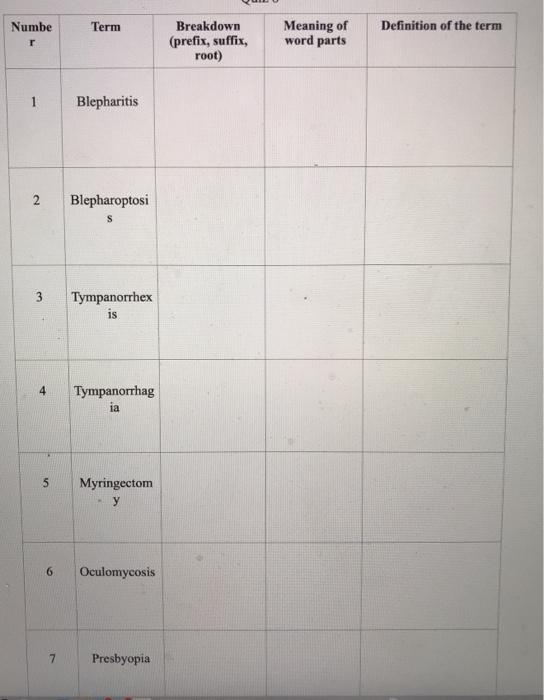
Term Definition of the term Numbe r Breakdown (prefix, suffix, root) Meaning of word parts 1 Blepharitis 2 Blepharoptosi S 3 Tympanorrhex is 4 Tympanorrhag ia 5 Myringectom ? 6 Oculomycosis Presbyopia 6 Oculomycosis 7 7 Presbyopia 8 -1- Bio 22 / Medical Terminology ? B D E 8 Iridectomy 9 10 Keratitis Break down th
The Correct Answer and Explanation is:
Here’s the completed medical terminology table for the provided terms, with breakdowns, word part meanings, and definitions. A brief explanation follows.
Completed Table
| Number | Term | Breakdown (prefix, suffix, root) | Meaning of Word Parts | Definition of the Term |
|---|---|---|---|---|
| 1 | Blepharitis | Blephar- (eyelid) + -itis (inflammation) | Blephar: eyelid, -itis: inflammation | Inflammation of the eyelid |
| 2 | Blepharoptosis | Blephar- (eyelid) + -ptosis (drooping) | Blephar: eyelid, -ptosis: drooping | Drooping of the eyelid |
| 3 | Tympanorrhexis | Tympan- (eardrum) + -rrhexis (rupture) | Tympan: eardrum, -rrhexis: rupture | Rupture of the eardrum |
| 4 | Tympanorrhagia | Tympan- (eardrum) + -rrhagia (bleeding) | Tympan: eardrum, -rrhagia: bursting forth of blood | Bleeding from the eardrum |
| 5 | Myringectomy | Myring- (eardrum) + -ectomy (removal) | Myring: eardrum, -ectomy: surgical removal | Surgical removal of the eardrum |
| 6 | Oculomycosis | Oculo- (eye) + myc- (fungus) + -osis (condition) | Oculo: eye, myc: fungus, -osis: abnormal condition | Fungal infection of the eye |
| 7 | Presbyopia | Presby- (old age) + -opia (vision condition) | Presby: aging, -opia: vision condition | Age-related loss of near vision |
| 8 | Iridectomy | Irid- (iris) + -ectomy (removal) | Irid: iris, -ectomy: surgical removal | Surgical removal of part or all of the iris |
| 9 | Keratitis | Kerat- (cornea) + -itis (inflammation) | Kerat: cornea, -itis: inflammation | Inflammation of the cornea |
Explanation
Medical terminology is primarily constructed from Latin and Greek word parts—prefixes, roots, and suffixes—which help in understanding the meanings of complex terms. For instance, “blepharitis” comes from blephar- (eyelid) and -itis (inflammation), clearly indicating inflammation of the eyelid. Similarly, “blepharoptosis” uses -ptosis, meaning drooping, helping us identify it as eyelid drooping.
Terms related to the ear often use tympan- (eardrum) or myring- (another term for eardrum). For example, “tympanorrhexis” includes -rrhexis meaning rupture, so the full term indicates a ruptured eardrum. “Tympanorrhagia” uses -rrhagia, meaning bleeding, defining it as bleeding from the eardrum.
In eye-related terms, oculo- refers to the eye. “Oculomycosis” includes myc- (fungus) and -osis (condition), defining it as a fungal infection of the eye. “Presbyopia” comes from presby- (old age) and -opia (vision), indicating age-related farsightedness due to loss of lens elasticity.
Surgical terms often end in -ectomy, meaning surgical removal. “Myringectomy” and “iridectomy” involve removal of the eardrum and iris respectively. “Keratitis” refers to inflammation of the kerat- (cornea), again using -itis.
By dissecting these terms into their components, we can understand unfamiliar medical language more easily and apply this knowledge across healthcare fields. This foundational understanding is critical for effective communication and documentation in clinical environments.