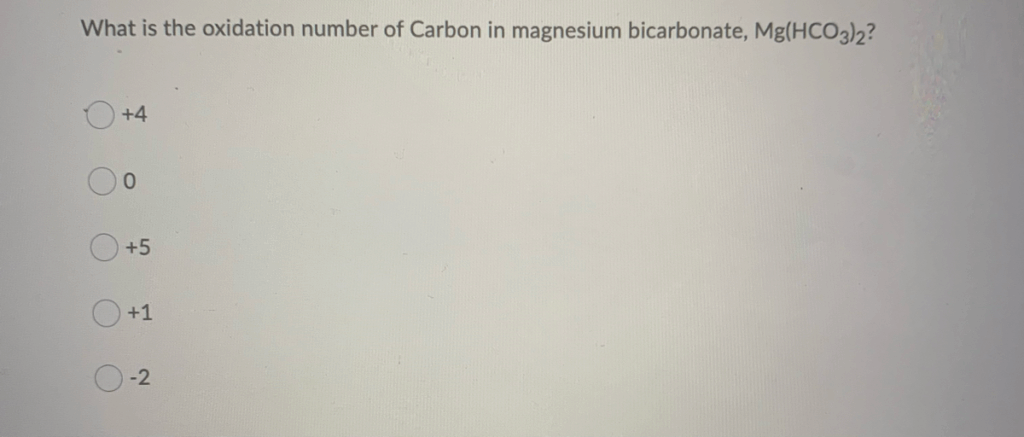
The Correct Answer and Explanation is:
Correct Answer: +4
Explanation:
To determine the oxidation number of carbon in magnesium bicarbonate, Mg(HCO₃)₂, we need to examine the structure and charges within the compound.
Step 1: Understand the compound
Magnesium bicarbonate is composed of:
- One magnesium ion (Mg²⁺),
- Two bicarbonate ions (HCO₃⁻).
Each bicarbonate ion contains:
- 1 hydrogen (H),
- 1 carbon (C),
- 3 oxygen (O).
The overall charge on the bicarbonate ion is –1.
Step 2: Assign known oxidation numbers
In HCO₃⁻:
- Hydrogen (H) has an oxidation number of +1.
- Oxygen (O) generally has an oxidation number of –2.
Let the oxidation number of carbon be x.
Using the rule that the sum of oxidation numbers in an ion equals its charge:
(+1) + x + 3(–2) = –1
+1 + x – 6 = –1
x – 5 = –1
x = +4
Therefore, the oxidation number of carbon in HCO₃⁻ is +4.
Step 3: Confirm with the full compound
Since Mg²⁺ is balanced by two HCO₃⁻ ions (each with a –1 charge), the compound is neutral, confirming our assumption about the ion charges and structure.
Summary:
The oxidation number of carbon in magnesium bicarbonate, Mg(HCO₃)₂, is +4. This is consistent with the general chemistry of the bicarbonate ion, where carbon is bonded to three oxygen atoms (one with a double bond, one single-bonded to an OH group, and one single-bonded with a negative charge). The calculation balances all oxidation numbers with the ion’s net charge.