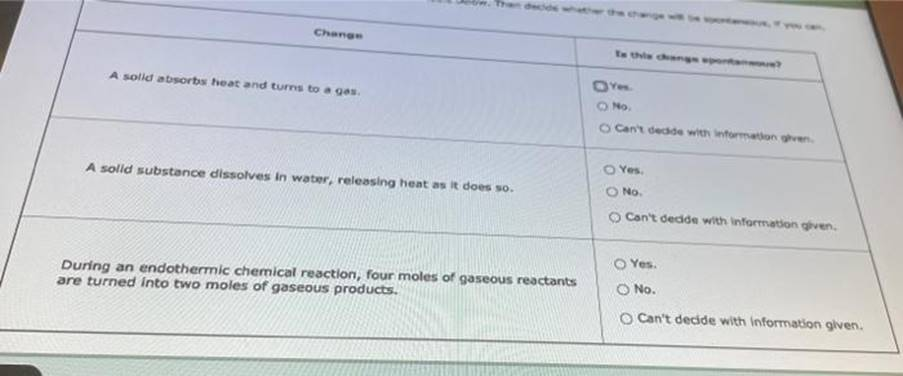
Can’t decide with informationen A solid substance dissolves in water, releasing heat as it does so. Yes. No. Can’t decide with information given Yes. During an endothermic chemical reaction, four moles of gaseous reactants are turned into two moles of gaseous products. No. Can’t decide with information given.
The Correct Answer and Explanation is:
Let’s analyze the spontaneity of each change based on thermodynamics, specifically Gibbs free energy (ΔG = ΔH – TΔS):
1. A solid absorbs heat and turns to a gas.
Correct Answer: Yes.
Explanation:
This is a phase transition (sublimation or vaporization) that absorbs heat (endothermic), meaning ΔH > 0. However, the entropy (ΔS) significantly increases because gases have much greater disorder than solids. At sufficiently high temperatures, the TΔS term outweighs ΔH, making ΔG = ΔH – TΔS negative. Therefore, the process becomes spontaneous at high temperatures. Since we are not restricted by temperature and this behavior is typical (like dry ice sublimation), we can conclude the change can be spontaneous.
2. A solid substance dissolves in water, releasing heat as it does so.
Correct Answer: Yes.
Explanation:
This process is exothermic (ΔH < 0), and usually, dissolving a solid increases entropy (ΔS > 0) due to greater dispersion of particles in solution. Therefore, both terms favor a negative ΔG:
- ΔH is negative
- ΔS is positive
This combination nearly always leads to spontaneous processes. A classic example is NaOH dissolving in water. Hence, the process is spontaneous under standard conditions.
3. During an endothermic chemical reaction, four moles of gaseous reactants are turned into two moles of gaseous products.
Correct Answer: No.
Explanation:
This reaction is endothermic (ΔH > 0), and the entropy decreases (ΔS < 0) because the number of gas molecules is reduced. Since both terms (positive ΔH and negative ΔS) work against spontaneity, ΔG = ΔH – TΔS will be positive at all temperatures, making the process non-spontaneous under standard conditions.
Final Summary of Correct Answers:
- Yes
- Yes
- No