Find the peak hour volume, peak hour factor (PHF), and the actual or design flow rate for an existing one-lane approach. To do this, you obtain a click-counter and position yourself at the intersection. For each fifteen-minute interval, you record the numbers of right-turns, left-turns, straight-through trucks, and straight-through passenger cars. Your tabulated values are as shown below. If a truck is equal to 1.5 passenger cars and a right-turn is as well, and if a left-turn is equal to 2.5 passenger cars, then calculate the peak hour volume, peak hour factor (PHF), and the actual (design) flow rate for this approach.
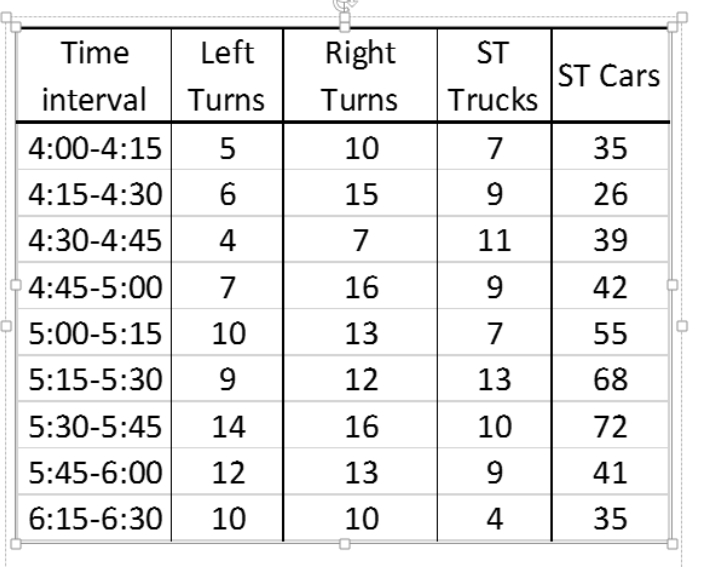
The Correct Answer and Explanation is:
Step-by-Step Solution
Step 1: Convert all vehicles to Passenger Car Equivalents (PCE)
Given:
- 1 Truck = 1.5 Passenger Cars
- 1 Right Turn = 1.5 Passenger Cars
- 1 Left Turn = 2.5 Passenger Cars
We calculate the total PCE for each 15-minute interval:
| Interval | Left Turns (×2.5) | Right Turns (×1.5) | ST Trucks (×1.5) | ST Cars | Total PCE |
|---|---|---|---|---|---|
| 4:00–4:15 | 5×2.5 = 12.5 | 10×1.5 = 15.0 | 7×1.5 = 10.5 | 35 | 73.0 |
| 4:15–4:30 | 6×2.5 = 15.0 | 15×1.5 = 22.5 | 9×1.5 = 13.5 | 26 | 77.0 |
| 4:30–4:45 | 4×2.5 = 10.0 | 7×1.5 = 10.5 | 11×1.5 = 16.5 | 39 | 76.0 |
| 4:45–5:00 | 7×2.5 = 17.5 | 16×1.5 = 24.0 | 9×1.5 = 13.5 | 42 | 97.0 |
| 5:00–5:15 | 10×2.5 = 25.0 | 13×1.5 = 19.5 | 7×1.5 = 10.5 | 55 | 110.0 |
| 5:15–5:30 | 9×2.5 = 22.5 | 12×1.5 = 18.0 | 13×1.5 = 19.5 | 68 | 128.0 |
| 5:30–5:45 | 14×2.5 = 35.0 | 16×1.5 = 24.0 | 10×1.5 = 15.0 | 72 | 146.0 |
| 5:45–6:00 | 12×2.5 = 30.0 | 13×1.5 = 19.5 | 9×1.5 = 13.5 | 41 | 104.0 |
| 6:15–6:30 | 10×2.5 = 25.0 | 10×1.5 = 15.0 | 4×1.5 = 6.0 | 35 | 81.0 |
Step 2: Identify Peak Hour
We now sum 4 consecutive intervals (1 hour):
- 4:00–5:00 → 73 + 77 + 76 + 97 = 323
- 4:15–5:15 → 77 + 76 + 97 + 110 = 360
- 4:30–5:30 → 76 + 97 + 110 + 128 = 411
- 4:45–5:45 → 97 + 110 + 128 + 146 = 481 ⬅️ Peak Hour
- 5:00–6:00 → 110 + 128 + 146 + 104 = 488 ⬅️ Peak Hour (MAX)
- 5:15–6:15 → 128 + 146 + 104 + 81 = 459
✅ Peak Hour Volume = 488 PCE
Step 3: Calculate PHF (Peak Hour Factor)
PHF=Total Volume in Peak Hour4×Highest 15-min Volume in Peak Hour\text{PHF} = \frac{\text{Total Volume in Peak Hour}}{4 \times \text{Highest 15-min Volume in Peak Hour}}
In peak hour 5:00–6:00, the 15-min volumes are:
- 110, 128, 146, 104 → Max = 146
PHF=4884×146=488584≈0.8356\text{PHF} = \frac{488}{4 \times 146} = \frac{488}{584} \approx 0.8356
Step 4: Calculate Design Flow Rate (v)
v=Peak Hour VolumePHF×1 hour=4880.8356≈584.1 PCE/hourv = \frac{\text{Peak Hour Volume}}{\text{PHF} \times 1 \text{ hour}} = \frac{488}{0.8356} \approx 584.1 \text{ PCE/hour}
Final Answers
- Peak Hour Volume: 488 PCE
- PHF: 0.836
- Design Flow Rate: 584 PCE/hour
Explanation
The peak hour volume, peak hour factor (PHF), and design flow rate are key metrics used in traffic analysis to evaluate the performance of a roadway segment, especially at intersections. These values help engineers determine whether the current infrastructure meets traffic demand or if improvements are needed.
To begin, we collected traffic counts over 15-minute intervals, recording the number of vehicles by type and movement. However, not all vehicles affect traffic flow equally; for example, trucks and turning vehicles often take more time and space. To account for this, we convert each vehicle type to Passenger Car Equivalents (PCE) using industry-standard factors: trucks and right-turns count as 1.5 PCE, while left-turns are 2.5 PCE due to their higher disruption potential.
Next, we calculate the total PCE for each 15-minute interval. We then sum four consecutive intervals to determine the peak hour — the hour with the highest total PCE. In this case, the interval from 5:00–6:00 PM had the highest volume: 488 PCE.
The PHF measures the variability of traffic flow within the peak hour. A PHF of 1.0 indicates uniform flow; lower values signal more peaked demand. It is calculated by dividing the total peak hour volume by four times the highest 15-minute interval volume. Our PHF of 0.836 suggests notable peaking behavior, meaning most traffic is concentrated in a short burst.
Finally, the design flow rate is the adjusted traffic flow used for designing the lane, incorporating peaking by dividing the peak hour volume by the PHF. This yields 584 PCE/hour — the true load the lane should be able to accommodate.