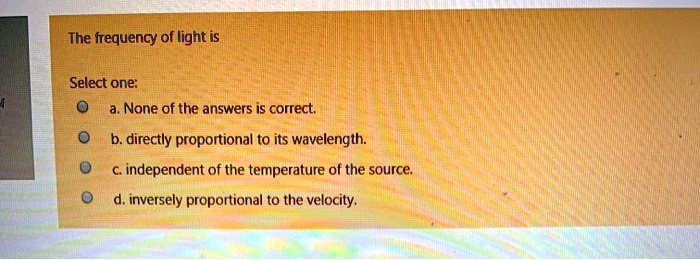
The frequency of light is Select one: a. None of the answers is correct. b. directly proportional to its wavelength. c. independent of the temperature of the source. d. inversely proportional to the velocity.
The frequency of light is Select one: a. None of the answers is correct. b. directly proportional to its wavelength. c. independent of the temperature of the source. d. inversely proportional to the velocity.
The Correct Answer and Explanation is:
The correct answer is:
a. None of the answers is correct.
Explanation:
To understand why none of the provided answers are correct, let’s analyze the nature of light and the relationships between frequency, wavelength, velocity, and source characteristics.
1. Basic Relationship
The frequency (f) of light is related to its wavelength (λ) and velocity (v) by the equation: v=fλv = f \lambda
For light in a vacuum, this becomes: c=fλc = f \lambda
Where c is the speed of light in a vacuum (~3.0 × 10⁸ m/s).
From this, we can derive: f=cλf = \frac{c}{\lambda}
This means that frequency is inversely proportional to wavelength, not directly proportional. So option b is incorrect.
2. Temperature Dependence
Option c states that the frequency is independent of the temperature of the source. While it’s true that the frequency of individual photons does not depend on temperature, the distribution of emitted frequencies (in blackbody radiation, for example) does depend on temperature. Hotter objects emit higher-frequency light on average. So this statement is misleading or incomplete.
3. Frequency and Velocity
Option d says frequency is inversely proportional to velocity. In a medium other than vacuum, the wavelength changes, not the frequency. The frequency of light remains constant when it enters a different medium; it is the speed and wavelength that change. Therefore, frequency is not inversely proportional to velocity. So option d is also incorrect.
Conclusion:
None of the provided choices are entirely correct, making option a the best answer. Understanding the precise relationships and physical principles is essential for accurately interpreting these types of questions.