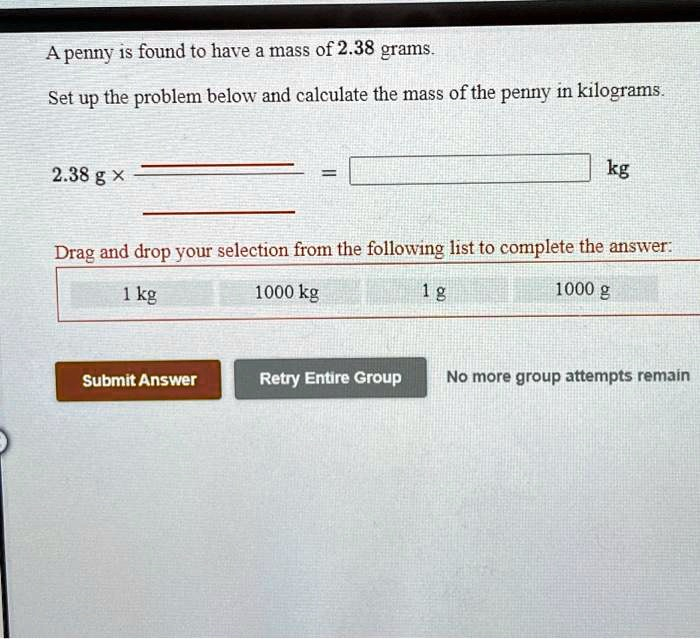
A penny is found to have a mass of 2.38 grams. Set up the problem below and calculate the mass of the penny in kilograms.
The Correct Answer and Explanation is:
Numeric answer 2.38 g×1 kg1000 g=0.00238 kg2.38\ \text{g}\times\frac{1\ \text{kg}}{1000\ \text{g}} = 0.00238\ \text{kg}
So the mass of the penny is 0.002 38 kg (2.38 × 10⁻³ kg).
explanation
Unit conversions in science always follow the same blueprint: multiply the given quantity by a carefully chosen conversion factor that equals 1, so the numeric value changes but the physical amount remains the same. Here the penny’s mass is expressed in grams (g), yet we want kilograms (kg). Because both units are in the metric system, the relationship is straightforward: 1 kg=1000 gor1000 g=1 kg.1\ \text{kg}=1000\ \text{g}\qquad\text{or}\qquad 1000\ \text{g}=1\ \text{kg}.
Either form can serve as a conversion factor. The trick is to pick the fraction that places the unit you have in the denominator, ensuring it cancels, while the unit you want stays in the numerator. We begin with 2.38 g, so we use 1 kg1000 g.\frac{1\ \text{kg}}{1000\ \text{g}}.
Notice this ratio is literally “one” in disguise; numerically it equals 1 because the numerator and denominator represent the same mass. Multiplying by it therefore changes only the unit labels and scale.
Write the set-up: 2.38 g×1 kg1000 g.2.38\ \text{g}\times\frac{1\ \text{kg}}{1000\ \text{g}}.
Grams appear once on top and once on the bottom, so they cancel, leaving kilograms as the surviving unit—exactly our goal. Now perform the arithmetic on the numbers: divide 2.38 by 1000. Moving the decimal three places to the left (because 1000 = 10³) gives 0.00238. The result carries the unit that did not cancel, kg.
Why keep all five significant figures? The original measurement, 2.38 g, has three significant figures, so the answer must as well. Writing 0.00238 kg (or 2.38 × 10⁻³ kg) preserves that precision.
This method scales to any conversion—liters to milliliters, meters to inches, even complex ones like miles per hour to meters per second—by chaining as many “equals-one” factors as necessary. Always track your units, cancel them systematically, and the numbers will practically solve themselves.
