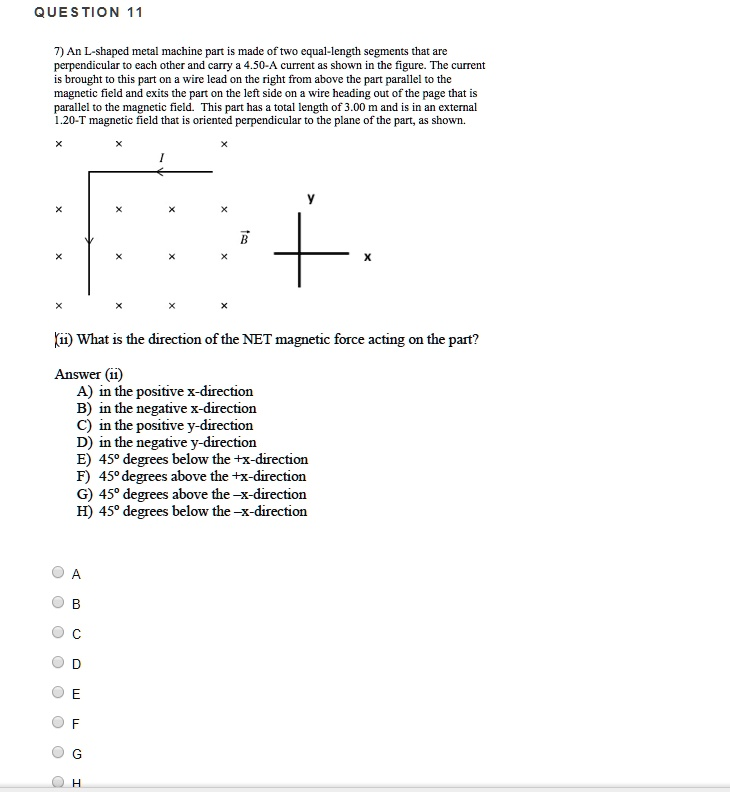
QUESTION 11 7) An L-shaped metal machine part made of two equal-length segments that are perpendicular to each other and carry 450- current as shown in the figure: The current enters this part on a wire lead on the right from above the part, parallel to the magnetic field, and exits the part on the left side on a wire heading out of the page, parallel to the magnetic field. This part has a total length of 3.00 m and is in an external 1.20- magnetic field that is oriented perpendicular to the plane of the part shown. Ki) What is the direction of the NET magnetic force acting on the part? Answer 8) in the positive x-direction in the negative x-direction in the positive y-direction D) in the negative Y-direction 45 degrees below the +x-direction 45 degrees above the +x-direction 45 degrees above the x-direction 45 degrees below the -x-direction
The Correct Answer and Explanation is:
Correct choice: E) “45 degrees below the +x-direction.”
Because the magnetic field B is drawn with 𝑥’s, it points into the page (– 𝑧). The L-shaped conductor has two straight, equal-length segments that carry the 4.50 A current at right angles to each other:
| Segment | Current direction I | I × B (force direction) |
|---|---|---|
| Top horizontal | to the left (– 𝑥) | (– 𝑥) × (– 𝑧) = – 𝑦 (down) |
| Left vertical | downward (– 𝑦) | (– 𝑦) × (– 𝑧) = + 𝑥 (right) |
(Right-hand rule: point your fingers along I, curl them into B; your thumb shows F.)
1. Force on the horizontal segment
With I along –𝑥 and B along –𝑧, the cross-product gives a force straight down (–𝑦).
2. Force on the vertical segment
With I along –𝑦 and B along –𝑧, the cross-product is toward +𝑥 (to the right).
3. Comparing magnitudes
For a straight wire in a uniform field, F=I L Bsinθ.F = I\,L\,B\sin\theta .
Both arms are perpendicular to B (θ = 90°) and have the same length (½ of the 3.00 m total, so 1.50 m each). Consequently, each segment experiences the same magnitude of force F=I(1.50 m)BF = I(1.50\ \text{m})B.
4. Vector addition
Add the two equal-magnitude force vectors:
- F1=F (−y^) \mathbf{F}_1 = F\,(-\hat{\mathbf y})
- F2=F (+x^) \mathbf{F}_2 = F\,(+\hat{\mathbf x})
The resultant is Fnet=F(+x^)+F(−y^)\mathbf{F}_{\text{net}} = F(+\hat{\mathbf x}) + F(-\hat{\mathbf y})
which points exactly halfway between +𝑥 and –𝑦. That direction is 45° below the +𝑥-axis (into the fourth quadrant of the xy-plane).
5. Summary
Each arm pulls equally but in perpendicular directions; when those forces are combined, the part as a whole feels a single force directed down-and-to-the-right. Hence, the net magnetic force is 45 degrees below the +x-direction—option E.