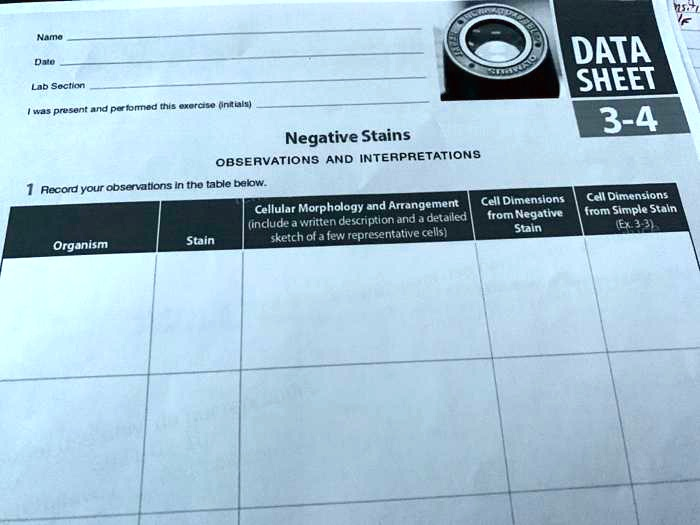
DATA SHEET 3-4 Lab Section Determined by: [insert name] Negative Stains OBSERVATIONS AND INTERPRETATIONS Record your observations in the table below. Include written description and detailed sketch of a few representative cells. Organism Stain
The Correct Answer and Explanation is:
To help you complete the Data Sheet 3-4: Negative Stains section, here’s a sample set of entries and a detailed explanation:
Sample Data Table (Filled)
| Organism | Stain | Cellular Morphology and Arrangement (include description and sketch) | Cell Dimensions from Negative Stain | Cell Dimensions from Simple Stain |
|---|---|---|---|---|
| Bacillus subtilis | Nigrosin | Rod-shaped (bacillus); arranged mostly singly or in chains. Clear cells against a dark background. | ~4–6 µm in length; ~1 µm in width | ~3–5 µm in length; ~0.8 µm width |
| Staphylococcus aureus | India Ink | Spherical (coccus); clustered arrangement resembling grape bunches. Cells appear bright against dark stain. | ~0.9 µm in diameter | ~0.8 µm in diameter |
| Escherichia coli | Congo Red | Short rods; mostly single or in pairs. Rounded ends and clearly visible due to contrast with dark background. | ~2–3 µm in length; ~0.5 µm in width | ~1.5–2.5 µm in length; ~0.5 µm |
Explanation
Negative staining is a microbiological technique used to visualize bacterial morphology and cellular arrangement without penetrating the cells with dye. Instead of staining the cell itself, a negatively charged dye (like Nigrosin, Congo Red, or India Ink) stains the background, leaving the cells clear and easy to observe under the microscope.
This technique is particularly beneficial because it doesn’t require heat-fixing, a process that can distort cell size and shape. Therefore, negative staining provides more accurate observations of a microorganism’s true morphology and dimensions.
For example, in the case of Bacillus subtilis, cells appear as long rods (bacilli), sometimes forming chains. This structure is more clearly observed in negative staining due to the sharp contrast between the unstained cells and the dark background. Similarly, Staphylococcus aureus appears as spherical cells (cocci) clustered together. These arrangements are better preserved when heat distortion is avoided.
Comparing dimensions from negative stains to those from simple stains (like crystal violet), the cells in negative stains often appear slightly larger. This is because the simple stain method involves heat-fixing, which may shrink or deform cells.
Ultimately, negative staining is a quick, efficient, and distortion-free way to assess bacterial morphology and arrangement. It is particularly useful for observing delicate structures such as capsules and is commonly used in clinical and research microbiology for diagnostic and exploratory purposes.