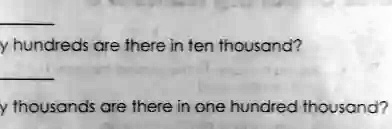
How many hundreds are there in ten thousand? How many thousands are there in one hundred thousand?
The Correct Answer and Explanation is:
Answers
- 100 hundreds are contained in ten thousand.
- 100 thousands are contained in one hundred thousand.
Why those numbers make sense
Our everyday number system is base 10, meaning every step to the left in a numeral is worth ten times the place immediately to its right. The familiar sequence of place-value names therefore follows simple powers of ten:
- Ones (10⁰ = 1)
- Tens (10¹ = 10)
- Hundreds (10² = 100)
- Thousands (10³ = 1 000)
- Ten-thousands (10⁴ = 10 000)
- Hundred-thousands (10⁵ = 100 000)
- …and so on.
Part 1: Hundreds inside 10 000
Ten-thousand is 10 000, which can be rewritten as a product of a hundred and another whole number: 10 000÷100 = 104÷102 = 102 = 100.10\,000 \div 100 \;=\; 10^{4} \div 10^{2} \;=\; 10^{2} \;=\; 100.
Because dividing by 100 strips away two zeros, we are left with 100. In other words, if you grouped the quantity 10 000 into packets of 100 each, you would fill exactly one hundred packets—no more, no less.
Part 2: Thousands inside 100 000
One-hundred-thousand is 100 000, which sits one power of ten higher than ten-thousand. To see how many complete blocks of 1 000 fit inside, divide by 1 000: 100 000÷1 000 = 105÷103 = 102 = 100.100\,000 \div 1\,000 \;=\; 10^{5} \div 10^{3} \;=\; 10^{2} \;=\; 100.
Again we reach 100, this time representing one hundred collections of one-thousand.
A broader way to see it
More generally, when you move down two place values—for example from ten-thousands to hundreds or from hundred-thousands to thousands—you always change by a factor of 10² = 100. That is why both questions share the same numerical answer even though they involve different absolute sizes.
Understanding this relationship is powerful: it lets you convert smoothly between place values without counting individual units. You simply ask, “How many powers of ten separate the two places?” Each power of ten corresponds to a division (or multiplication) by 10, and the exponent tells you how many zeros—and therefore what factor—you must use.