pair geometry? What is the molecular geometry? Estimate the bond angle. Is this molecule polar? If so, draw the dipole arrow. Draw the Lewis structure for hydrogen cyanide, HCN. What is the electron pair geometry? What is the molecular geometry? Estimate the bond angle. Is this molecule polar? If so, draw the dipole arrow.
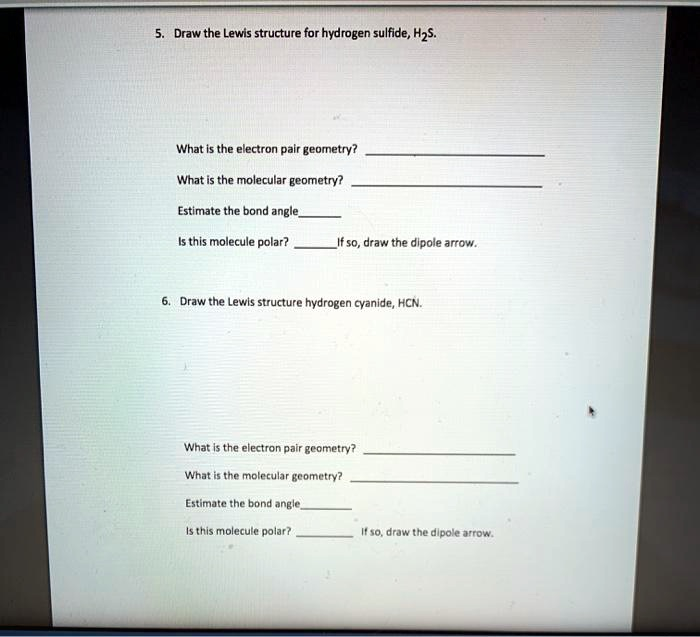
Draw the Lewis structure for hydrogen sulfide, H2S. What is the electron pair geometry? What is the molecular geometry? Estimate the bond angle. Is this molecule polar? If so, draw the dipole arrow. Draw the Lewis structure for hydrogen cyanide, HCN. What is the electron pair geometry? What is the molecular geometry? Estimate the bond angle. Is this molecule polar? If so, draw the dipole arrow.
The Correct Answer and Explanation is:
Hydrogen sulfide (H₂S)
- Lewis structure: H–S–H with two lone-pair dots on S (total 8 valence e⁻).
- Electron-pair geometry (VSEPR): tetrahedral (4 regions around S: 2 lone pairs + 2 bond pairs).
- Molecular geometry: bent (V-shaped) because the two lone pairs occupy two vertices of the tetrahedron, leaving the two S–H bonds at the other vertices.
- Estimated H–S–H bond angle: compressed well below the ideal 109.5 °; experimentally ≈ 92 °, usually quoted as ~95 °.
- Polarity: polar. Each S–H bond dipole points from H toward the more-electronegative S; the two dipoles reinforce, giving a net vector from the midpoint of the H–H line toward S (draw the arrow from between the H atoms toward S, bar at the H end).
Hydrogen cyanide (HCN)
- Lewis structure: H–C≡N with a lone pair on N (10 valence e⁻).
- Electron-pair geometry about C: linear (2 regions: one σ bond to H and one σ bond of the C≡N triple).
- Molecular geometry: linear.
- Estimated H–C–N bond angle: 180 °.
- Polarity: polar. The C≡N bond dipole (points toward N) is larger than the opposite-directed C–H dipole, so the overall molecular dipole points from the H end through C toward N (arrow head at N, plus sign near H).
Why these answers
VSEPR theory relates molecular shape to the number of electron-density regions (bonding + lone pairs) around a central atom. Each region repels the others, adopting a geometry that maximizes separation.
In H₂S the sulfur atom supplies six valence electrons; two are used for the S–H σ bonds, leaving two lone pairs. Four regions around S give a tetrahedral electron framework. Lone pairs repel more strongly than bonding pairs, pushing the S–H bonds closer together, so the observed angle (≈ 92 °) is much smaller than the ideal 109.5 °. Unequal electronegativities (χ S = 2.58 > χ H = 2.20) make each S–H bond polar. Because the vector sum of the two bond dipoles is non-zero, H₂S has a net dipole (≈ 0.97 D), explaining its moderate water solubility and higher boiling point compared with H₂.
In HCN carbon contributes four electrons, forming one σ bond to H and one σ + two π bonds to N (a triple bond counts as a single region in VSEPR). Two regions demand a linear arrangement, so the H–C–N axis is 180 °. Although the C–H bond dipole points slightly toward C (χ C = 2.55), the much stronger C≡N dipole (χ N = 3.04) dominates, giving a net moment (≈ 3.0 D) toward nitrogen. The polarity, plus the linear shape, accounts for HCN’s high toxicity: its small, polar molecules cross biological membranes readily and bind to cytochrome oxidase.
Thus, VSEPR, electronegativity differences, and dipole-vector addition together explain both molecular shapes and polarities.