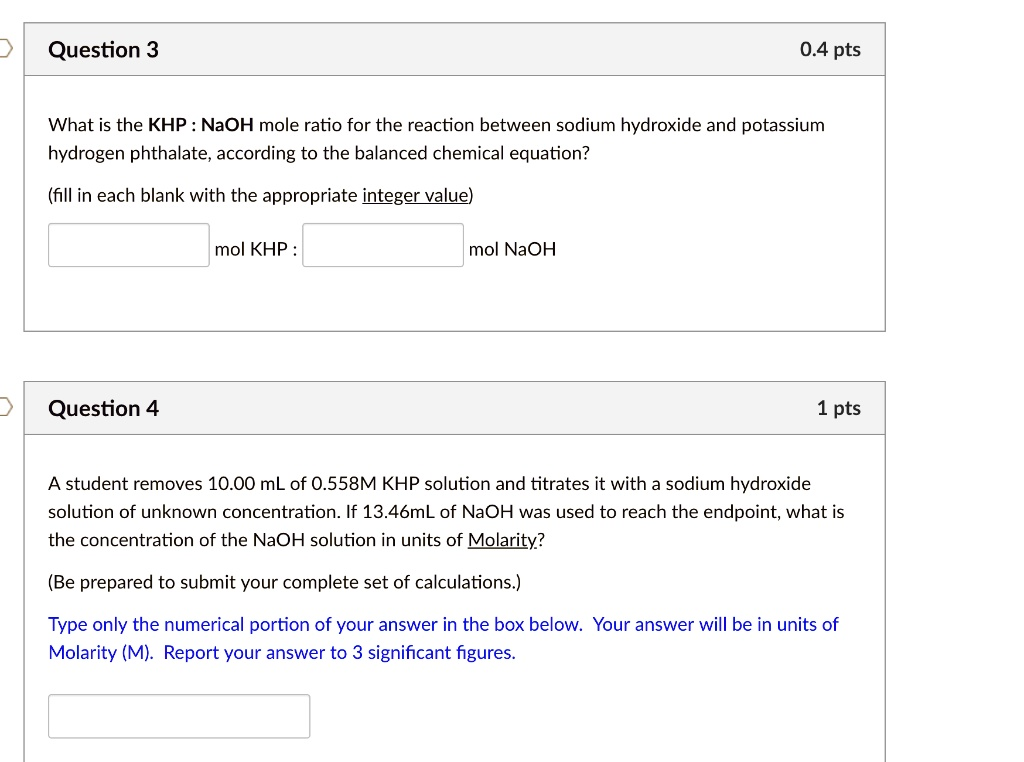
What is the KHP: NaOH mole ratio for the reaction between sodium hydroxide and potassium hydrogen phthalate, according to the balanced chemical equation? (fill in each blank with the appropriate integer value) Question 4 mol KHP : mol NaOH 1 pts A student removes 10.00 mL of 0.558M KHP solution and titrates it with a sodium hydroxide solution of unknown concentration. If 13.46mL of NaOH was used to reach the endpoint, what is the concentration of the NaOH solution in units of Molarity? (Be prepared to submit your complete set of calculations.) Type only the numerical portion of your answer in the box below. Your answer will be in units of Molarity (M). Report your answer to 3 significant figures.
Question 3 0.4 pts What is the KHP: NaOH mole ratio for the reaction between sodium hydroxide and potassium hydrogen phthalate, according to the balanced chemical equation? (fill in each blank with the appropriate integer value) Question 4 mol KHP : mol NaOH 1 pts A student removes 10.00 mL of 0.558M KHP solution and titrates it with a sodium hydroxide solution of unknown concentration. If 13.46mL of NaOH was used to reach the endpoint, what is the concentration of the NaOH solution in units of Molarity? (Be prepared to submit your complete set of calculations.) Type only the numerical portion of your answer in the box below. Your answer will be in units of Molarity (M). Report your answer to 3 significant figures
The Correct Answer and Explanation is:
Correct answers
- Question 3: 1 mol KHP : 1 mol NaOH
- Question 4: 0.415 (M, to three significant figures)
explanation
Potassium hydrogen phthalate (usually abbreviated KHP) is a monoprotic acid: although its formula is KHC₈H₄O₄, only the single acidic hydrogen (the one bound to the carboxylic group) can be neutralised by a base. In aqueous solution it therefore reacts with sodium hydroxide in a simple 1 : 1 fashion:
KHC₈H₄O₄ (aq) + NaOH (aq) → KNaC₈H₄O₄ (aq) + H₂O (l)
Because each reactant carries a coefficient of one, the balanced chemical equation tells us the mole ratio of KHP to NaOH is 1 : 1. That integer relationship is the key to every titration calculation that follows.
In the experiment, 10.00 mL of a 0.558 M KHP solution was transferred to a flask. Converting the delivery volume to litres (0.01000 L) and applying the definition n = C × V gives the amount of substance present:
n(KHP) = 0.558 mol L⁻¹ × 0.01000 L = 5.58 × 10⁻³ mol.
Because the stoichiometric ratio is 1 : 1, exactly the same number of moles of NaOH must be delivered from the burette to reach the equivalence point:
n(NaOH) = 5.58 × 10⁻³ mol.
The burette reading shows that 13.46 mL of NaOH—equivalent to 0.01346 L—was required. Molarity is defined as moles divided by litres, so the concentration of the base is obtained directly:
C(NaOH) = n / V
= 5.58 × 10⁻³ mol ÷ 0.01346 L
= 0.4146 M.
The value must be rounded to match the precision requested (three significant figures), giving 0.415 M.
This result is internally consistent: the base concentration is a little lower than that of the acid, and the volume of base used is correspondingly larger (13.46 mL versus 10.00 mL), reflecting the inverse relationship between volume and molarity for a fixed mole requirement. The exercise exemplifies how a primary standard such as KHP—chosen for its high purity, stability, and large molar mass—can transfer its concentration accuracy to a secondary reagent through straightforward stoichiometry and careful volumetric measurements.
