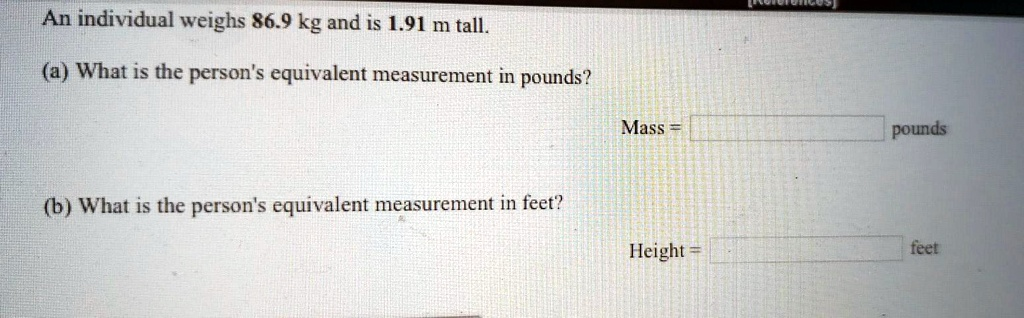
An individual weighs 86.9 kg and is 1.91 m tall (a) What is the person’s equivalent measurement in pounds? Mass pounds (b) What is the person’s equivalent measurement in feet? Height= fee
The Correct Answer and Explanation is:
Let’s solve both parts of the question using unit conversions.
Given:
- Weight = 86.9 kg
- Height = 1.91 meters
(a) Convert kg to pounds:
Conversion factor:
1 kilogram = 2.20462 pounds
Calculation: 86.9 kg×2.20462=191.556 pounds86.9 \, \text{kg} \times 2.20462 = 191.556 \, \text{pounds}
Answer:
Mass = 191.56 pounds
(b) Convert meters to feet:
Conversion factor:
1 meter = 3.28084 feet
Calculation: 1.91 m×3.28084=6.2664 feet1.91 \, \text{m} \times 3.28084 = 6.2664 \, \text{feet}
Answer:
Height = 6.27 feet
Explanation
This problem involves converting metric units (kilograms and meters) into imperial units (pounds and feet), which is a common requirement in science and engineering when dealing with international standards or mixed systems of measurement.
In part (a), the individual’s mass is provided in kilograms (kg), the standard unit of mass in the International System of Units (SI). To convert this to pounds (lb), the imperial unit of mass, we use the conversion factor 1 kg = 2.20462 lb. Multiplying 86.9 kg by this factor gives us approximately 191.56 pounds. This conversion is especially useful in countries like the United States where body weight is commonly discussed in pounds.
In part (b), the person’s height is given in meters (m), which is the SI unit for length. To convert it to feet, we use the conversion factor 1 meter = 3.28084 feet. When we multiply 1.91 meters by this factor, we get approximately 6.27 feet. Since there are 12 inches in a foot, this could also be expressed more precisely as 6 feet 3.2 inches for better intuitive understanding.
These types of conversions are essential in fields such as medicine, athletics, and engineering, where precise communication of measurements in various units can significantly impact outcomes. It’s also helpful for travelers and professionals who work in international contexts, making unit conversions an essential skill.
