Done
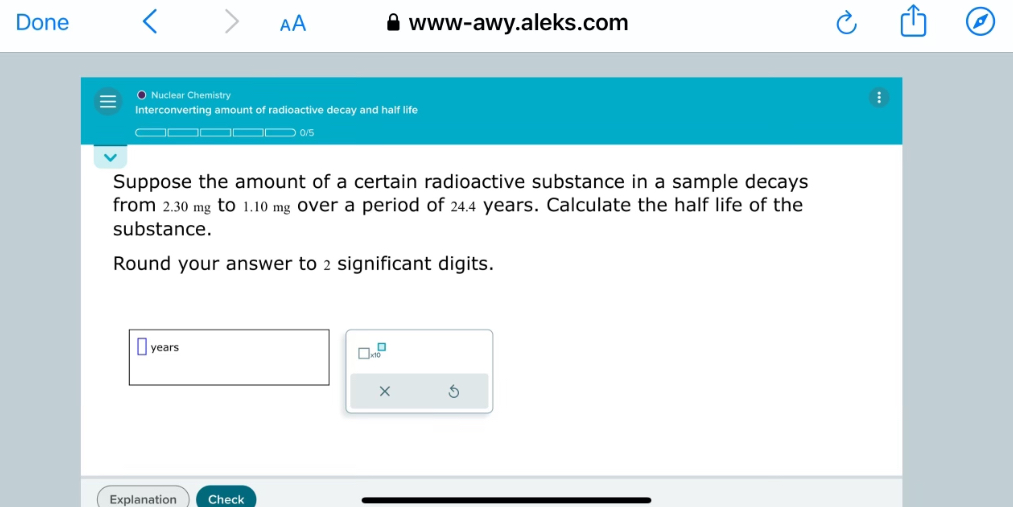
www-awy.aleks.com Nuclear Chemistry Interconverting amount of radioactive decay and half life
Suppose the amount of a certain radioactive substance in a sample decays from 2.30 mg to 1.10 mg over a period of 24.4 years. Calculate the half life of the substance. Round your answer to 2 significant digits.
years
5 Explanation Check
The Correct Answer and Explanation is:
To find the half-life of a radioactive substance, we use the formula for exponential decay: A=A0⋅(12)tT1/2A = A_0 \cdot \left(\frac{1}{2}\right)^{\frac{t}{T_{1/2}}}
Where:
- AA = final amount = 1.10 mg
- A0A_0 = initial amount = 2.30 mg
- tt = time = 24.4 years
- T1/2T_{1/2} = half-life (what we’re solving for)
Step 1: Set up the equation
1.10=2.30⋅(12)24.4T1/21.10 = 2.30 \cdot \left(\frac{1}{2}\right)^{\frac{24.4}{T_{1/2}}}
Step 2: Divide both sides by 2.30
1.102.30=(12)24.4T1/2⇒0.4783≈(12)24.4T1/2\frac{1.10}{2.30} = \left(\frac{1}{2}\right)^{\frac{24.4}{T_{1/2}}} \Rightarrow 0.4783 \approx \left(\frac{1}{2}\right)^{\frac{24.4}{T_{1/2}}}
Step 3: Take the logarithm of both sides
log(0.4783)=24.4T1/2⋅log(0.5)\log(0.4783) = \frac{24.4}{T_{1/2}} \cdot \log(0.5) −0.3202=24.4T1/2⋅(−0.3010)-0.3202 = \frac{24.4}{T_{1/2}} \cdot (-0.3010)
Step 4: Solve for T1/2T_{1/2}
T1/2=24.4⋅0.30100.3202≈7.34440.3202≈22.94T_{1/2} = \frac{24.4 \cdot 0.3010}{0.3202} \approx \frac{7.3444}{0.3202} \approx 22.94
Rounded to 2 significant digits, the half-life is: 23 years\boxed{23 \text{ years}}
Explanation (300 Words):
Radioactive decay follows a predictable exponential pattern, where a substance loses half of its mass over a fixed period known as the half-life. This problem provides initial and final masses of a radioactive sample, along with the time over which this decay occurs, and asks us to find the half-life.
To solve this, we apply the exponential decay formula, which reflects how radioactive materials reduce over time. The formula relates the initial and remaining amounts of the substance using the base 12\frac{1}{2}, because the material halves over each half-life period.
The first step is to plug in the given values: 2.30 mg as the starting mass, 1.10 mg as the remaining mass, and 24.4 years as the time elapsed. We isolate the exponential part by dividing the remaining amount by the initial amount. This gives us a ratio that tells us how much of the original material remains.
We then apply logarithms to both sides to bring the exponent down, enabling us to solve for the half-life algebraically. Logarithms are useful here because they allow us to manipulate exponents, which is essential when solving exponential equations.
After calculating the result, we round it to two significant digits, as required. The final answer is 23 years, meaning that every 23 years, the amount of this radioactive substance is halved under the given conditions.
This method is a standard approach in nuclear chemistry and radioactive dating, demonstrating how mathematical models help interpret physical decay processes.
