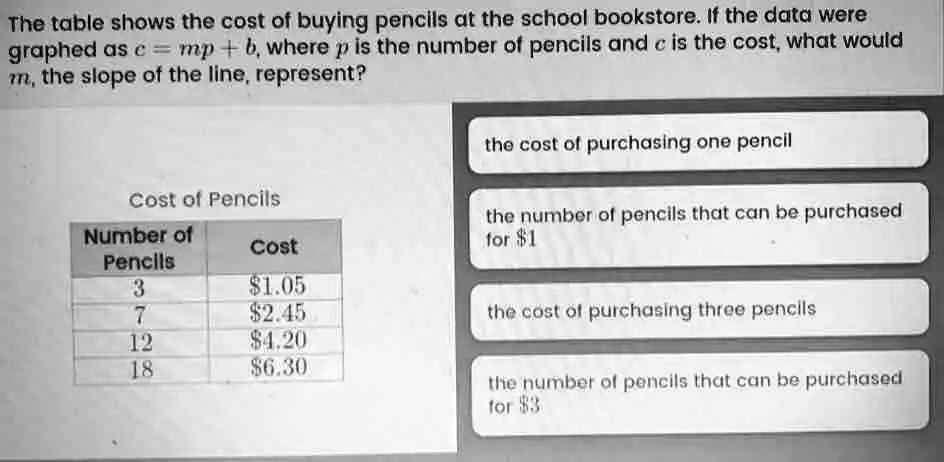
The table shows the cost of buying pencils at the school bookstore. If the data were graphed as
, where
is the number of pencils and
is the cost, what would
, the slope of the line, represent? Cost of Pencils Number of Cost Pencils 3
2.45 12
6.30 the cost of purchasing one pencil the number of pencils that can be purchased for
3
The Correct Answer and Explanation is:
To determine what the slope mm represents in the equation c=mp+bc = mp + b, where pp is the number of pencils and cc is the cost, let’s first understand the meaning of slope in a linear equation. The slope mm represents the rate of change of the cost with respect to the number of pencils — in other words, how much the cost increases for each additional pencil.
Step-by-Step Breakdown:
From the table:
| Number of Pencils | Cost |
|---|---|
| 3 | $1.05 |
| 7 | $2.45 |
| 12 | $4.20 |
| 18 | $6.30 |
We can find the slope mm using two points from the table. Let’s use the points (3, 1.05) and (7, 2.45). m=2.45−1.057−3=1.404=0.35m = \frac{2.45 – 1.05}{7 – 3} = \frac{1.40}{4} = 0.35
So, the slope m=0.35m = 0.35 means that each pencil costs $0.35.
Interpretation:
Since the slope tells us how much cost increases for each additional pencil, it represents the cost of purchasing one pencil. This is the rate at which total cost increases as the number of pencils increases.
Correct Answer:
✅ “the cost of purchasing one pencil”
Explanation
In the given scenario, the relationship between the number of pencils purchased and their total cost is linear, meaning it follows a straight-line pattern. This is modeled using the equation c=mp+bc = mp + b, where cc is the total cost, pp is the number of pencils, mm is the slope, and bb is the y-intercept (fixed base cost if any).
To interpret what the slope mm represents, we calculate it using two points from the data table. For example, from 3 pencils costing $1.05 and 7 pencils costing $2.45, we use the slope formula: m=ΔcΔp=2.45−1.057−3=1.404=0.35m = \frac{\Delta c}{\Delta p} = \frac{2.45 – 1.05}{7 – 3} = \frac{1.40}{4} = 0.35
This value of mm means that for each additional pencil, the total cost increases by $0.35. In other words, each pencil costs $0.35, which is the unit price per pencil.
Therefore, the slope mm directly represents the cost of purchasing one pencil, not the number of pencils per dollar or the cost for a specific number of pencils. It reflects a consistent unit price — a fundamental feature of linear pricing in real-life shopping scenarios.
This concept is crucial in understanding how unit rates work and how linear equations can model real-world data such as costs in a store.
