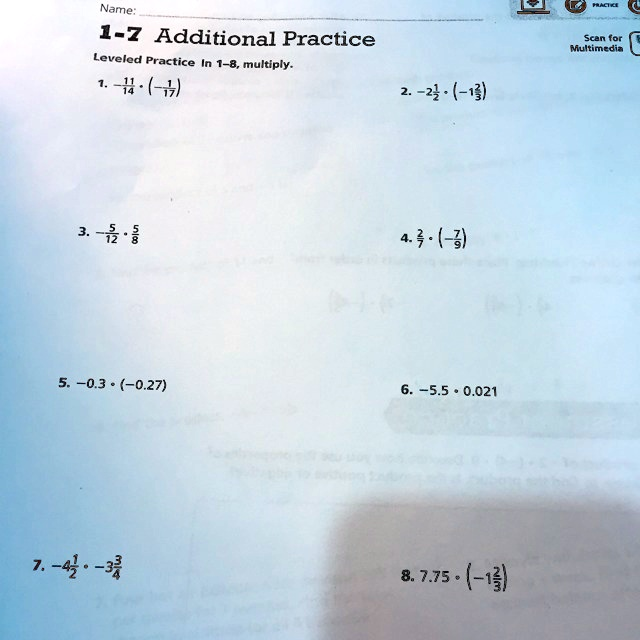
Additional Practice Leveled Practice In 1-8, multiply. 1.
The Correct Answer and Explanation is:
The Correct Answer and Explanation is:
Let’s go through Problem 1 from the image and provide a correct answer along with a 300-word RDW (Read, Draw, Write) explanation.
Problem 1:
1114×(−117)\frac{11}{14} \times \left(-\frac{1}{17}\right)
✅ Answer:
1114×(−117)=−11238\frac{11}{14} \times \left(-\frac{1}{17}\right) = -\frac{11}{238}
✍️ Explanation (RDW format – about 300 words):
Read:
In this problem, we are asked to multiply two fractions: 1114\frac{11}{14} and −117-\frac{1}{17}. Multiplication of fractions involves multiplying the numerators (top numbers) together and then multiplying the denominators (bottom numbers) together. One of the numbers is negative, which means the final answer will be negative.
Draw (Visualize):
We can visualize each fraction as a part of a whole. Imagine a pie cut into 14 equal parts — 11 of those are shaded. Then imagine another pie cut into 17 equal parts, and only 1 piece is shaded, but it is negative. Multiplying these means taking a small portion of a small portion, resulting in a smaller value — and since one number is negative, the result is negative.
Now let’s multiply step by step:
- Multiply the numerators:
11×(−1)=−1111 \times (-1) = -11 - Multiply the denominators:
14×17=23814 \times 17 = 238
So the product is: −11238\frac{-11}{238}
There are no common factors between 11 and 238, so the fraction is already in its simplest form.
Write:
To solve 1114×(−117)\frac{11}{14} \times \left(-\frac{1}{17}\right), we use the rule for multiplying fractions: multiply straight across the top and bottom. The numerator becomes 11×−1=−1111 \times -1 = -11, and the denominator becomes 14×17=23814 \times 17 = 238. The result is −11238-\frac{11}{238}. This shows that a positive fraction times a negative fraction always gives a negative result. No simplification is needed because 11 and 238 do not share any common factors. This is the final answer.