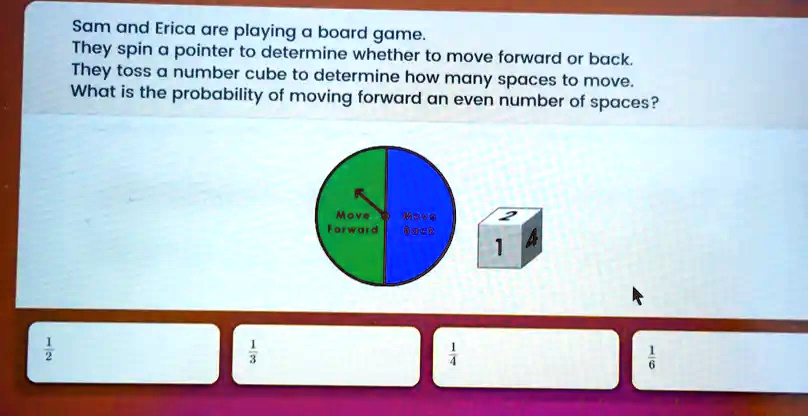
Sam and Erica are playing a board game. They spin a pointer to determine whether to move forward or back. They toss a number cube to determine how many spaces to move. What is the probability of moving forward an even number of spaces
The Correct Answer and Explanation is:
To solve this problem, we need to calculate the probability of two independent events happening together:
- Spinning the pointer to “Move Forward”.
- Tossing an even number on the number cube.
Step-by-step Analysis:
1. Spin Probability (Move Forward):
From the image, the spinner is divided into two sections:
- Green: “Move Forward”
- Blue: “Move Back”
We can see the spinner is split equally into two parts. So the probability of landing on “Move Forward” is: P(Move Forward)=12P(\text{Move Forward}) = \frac{1}{2}
2. Number Cube Probability (Even Number):
The number cube shown has 6 faces, presumably numbered from 1 to 6. Among these numbers, the even numbers are: 2, 4, and 6. So: P(Even Number)=36=12P(\text{Even Number}) = \frac{3}{6} = \frac{1}{2}
3. Combined Probability:
We are looking for the probability that both of the following happen:
- The player moves forward, and
- The number of spaces is an even number.
Since these are independent events, we multiply their probabilities: P(Forward and Even)=P(Move Forward)×P(Even Number)=12×12=14P(\text{Forward and Even}) = P(\text{Move Forward}) \times P(\text{Even Number}) = \frac{1}{2} \times \frac{1}{2} = \frac{1}{4}
✅ Final Answer: ¼
So, the correct choice is:
¼
Explanation
Sam and Erica are playing a board game that uses two tools to determine their move: a spinner and a number cube. The spinner decides the direction — either forward or backward — and the number cube decides how many spaces to move. The question asks for the probability of moving forward an even number of spaces, which means we need to consider both the direction (forward) and the number of spaces (even).
First, let’s examine the spinner. It is equally divided into two halves: one half says “Move Forward,” and the other says “Move Back.” Because the spinner is evenly divided, the chance of landing on either section is ½.
Next, consider the number cube. Typically, a number cube (or die) has six faces numbered from 1 to 6. Out of these, half — the numbers 2, 4, and 6 — are even. Therefore, the probability of rolling an even number is 3 out of 6, or ½.
To find the overall probability of both spinning “Move Forward” and rolling an even number, we multiply the two independent probabilities:
½ (move forward) × ½ (even number) = ¼.
This gives us the final answer: there is a ¼ probability that the player will move forward an even number of spaces. This kind of problem is a classic example of using the multiplication rule for independent events in probability.