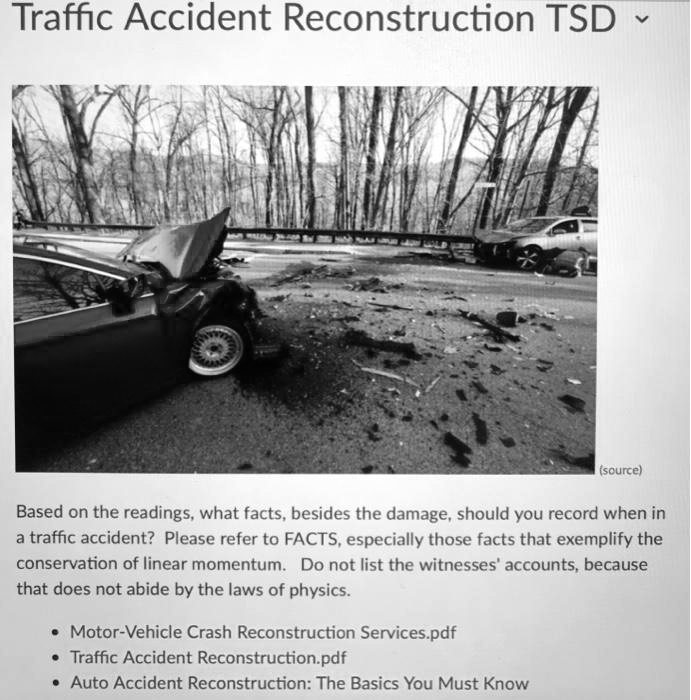
Traffic Accident Reconstruction TSD (source) Based on the readings, what facts, besides the damage, should you record when in a traffic accident? Please refer to FACTS, especially those facts that exemplify the conservation of linear momentum. Do not list the witnesses’ accounts because that does not abide by the laws of physics. Motor-Vehicle Crash Reconstruction Services PDF Traffic Accident Reconstruction PDF Auto Accident Reconstruction: The Basics You Must Know
The Correct Answer and Explanation is:
Correct Answer:
Besides the damage, the following facts should be recorded in a traffic accident, especially for the purpose of accurate accident reconstruction:
- Position and final resting place of vehicles
- Skid marks and yaw marks
- Pre- and post-impact directions of travel
- Vehicle weights and speeds (estimated)
- Road and weather conditions
- Point of impact (POI) and point of rest (POR)
- Debris distribution patterns
- Any signs of evasive action (e.g., steering or braking)
- Time and date of the accident
Explanation
When reconstructing a traffic accident, it’s essential to gather measurable, physics-based facts to accurately understand the events leading to and following the collision. While vehicle damage provides valuable insight, it is not sufficient on its own for a full reconstruction.
A critical principle in accident reconstruction is the conservation of linear momentum, which dictates that the total momentum of all vehicles before the crash should equal the total momentum after, assuming negligible external forces like friction or incline. To apply this, investigators must record data such as vehicle weights, pre- and post-impact speeds, and directions of movement. This allows for momentum vector calculations and helps determine responsibility.
Skid marks provide insight into braking behavior and can be used to estimate vehicle speeds using kinetic energy equations. The length, direction, and intensity of these marks also indicate attempts to avoid a collision. Yaw marks may show if a vehicle lost traction or attempted a sharp turn.
The point of impact (POI) and the final resting place of the vehicles (POR) are crucial for plotting the movement of the vehicles and understanding the dynamics of the crash. Additionally, debris patterns can help trace the exact moment and location of impact.
Road conditions, such as wetness, gravel, or oil, affect friction and braking efficiency, while weather and lighting may impact visibility. All of these factors contribute to an accurate, physics-based reconstruction.
By recording such objective and measurable data, investigators can reconstruct the incident scientifically, ensuring conclusions align with the laws of physics rather than subjective testimony