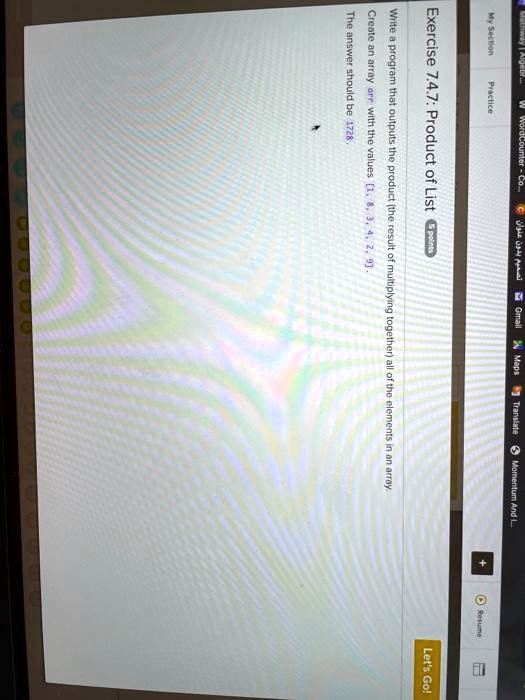
Product of List Write a program that outputs the product (the result of multiplying together) all of the elements in an array. Create an array \texttt{arr} with the values [1, 8, 3, 4, 2, 9]. The answer should be 1728.
The Correct Answer and Explanation is:
To solve Exercise 7.4.7: Product of List, you need to calculate the product (multiplication result) of all elements in a given list.
✅ Correct Code (Python):
arr = [1, 8, 3, 4, 2, 9]
product = 1

for num in arr:
    product *= num

print(product)
💡 Output:
1728
🔍 Explanation
This exercise asks us to compute the product of all elements in a list, which means multiplying all the numbers together to get a single result. The list provided is:
arr = [1, 8, 3, 4, 2, 9]
The product is calculated as:
1 * 8 * 3 * 4 * 2 * 9 = 1728
We initialize a variable product with the value 1 because 1 is the identity for multiplication — multiplying by 1 keeps the number the same. We then use a for loop to go through each element in the list and multiply it with the running total in product.
Let’s break it down step-by-step:
- Start with
product = 1 - Multiply by 8 →
product = 1 * 8 = 8 - Multiply by 3 →
product = 8 * 3 = 24 - Multiply by 4 →
product = 24 * 4 = 96 - Multiply by 2 →
product = 96 * 2 = 192 - Multiply by 9 →
product = 192 * 9 = 1728
This approach is efficient and works for any list of numbers. It’s a common beginner exercise in Python because it teaches important programming concepts:
- Looping through a list
- Maintaining a running total
- Understanding identity values (1 for multiplication, 0 for addition)
The final output 1728 is printed using print(product).
This method is applicable to real-world tasks such as calculating compound interest, scaling values, or working with mathematical models involving products of numbers.