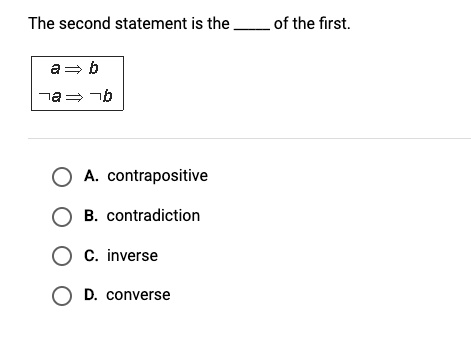
The second statement is the of the first. a= b 33 7b contrapositive contradiction inverse converse
The Correct Answer and Explanation is:
The correct answer is: C. inverse
Explanation:
The first statement given is:
- a⇒ba \Rightarrow b
This is a conditional statement, meaning if a is true, then b is also true.
The second statement is:
- ¬a⇒¬b\neg a \Rightarrow \neg b
This reads as if not a, then not b.
This type of transformation is called the inverse of a conditional statement.
Let’s break down the four terms to understand why:
- Original Statement (Conditional):
a⇒ba \Rightarrow b
“If a, then b.” - Inverse:
¬a⇒¬b\neg a \Rightarrow \neg b
This negates both the hypothesis and the conclusion of the original.
“If not a, then not b.”
→ This matches the second statement, so this is the correct answer. - Converse:
b⇒ab \Rightarrow a
This switches the hypothesis and conclusion without negating them.
“If b, then a.” - Contrapositive:
¬b⇒¬a\neg b \Rightarrow \neg a
This switches and negates both the hypothesis and conclusion.
“If not b, then not a.” - Contradiction:
A contradiction is a logical inconsistency, such as a statement that is always false (e.g., a∧¬aa \wedge \neg a).
→ This is not what’s happening here.
Summary:
- The inverse of a statement a⇒ba \Rightarrow b is ¬a⇒¬b\neg a \Rightarrow \neg b.
- This does not mean it is logically equivalent to the original statement (only the contrapositive is logically equivalent).
- Therefore, the second statement is the inverse of the first.
✅ Correct answer: C. inverse