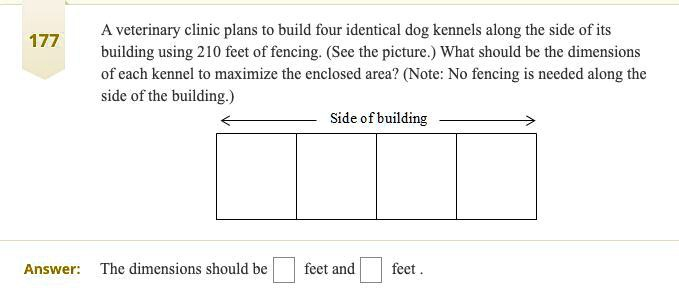
veterinary clinic plans to build four identical dog kennels along the side of its building using 210 feet of fencing. (See the picture.) What should be the dimensions of each kennel to maximize the enclosed area? (Note: No fencing is needed along the side of the building.) Side of building Answer: The dimensions should be feet and feet.
The Correct Answer and Explanation is:.
To solve this optimization problem, we need to determine the dimensions of each kennel that will maximize the enclosed area using 210 feet of fencing, given the constraints in the diagram.
Step-by-Step Solution:
Let:
- xx = depth of each kennel (distance perpendicular to the building)
- yy = width of each kennel (distance along the building)
There are 4 kennels, so we will need:
- 5 vertical dividers (4 between kennels + 1 at the far end)
- 4 horizontal fences (1 for each kennel opposite the building)
Thus, the total fencing used is: 5x+4y=2105x + 4y = 210
We want to maximize the total area, AA, of all four kennels: A=4xyA = 4xy
Step 1: Express one variable in terms of the other using the constraint
From: 5x+4y=210⇒y=210−5x45x + 4y = 210 \Rightarrow y = \frac{210 – 5x}{4}
Step 2: Plug into the area function
A=4x⋅y=4x⋅(210−5×4)=x(210−5x)A = 4x \cdot y = 4x \cdot \left(\frac{210 – 5x}{4}\right) = x(210 – 5x) A=210x−5x2A = 210x – 5x^2
Step 3: Maximize the area
This is a quadratic equation of the form: A=−5×2+210xA = -5x^2 + 210x
To find the maximum, use: x=−b2a=−2102(−5)=21010=21x = -\frac{b}{2a} = -\frac{210}{2(-5)} = \frac{210}{10} = 21
Step 4: Solve for yy
y=210−5(21)4=210−1054=1054=26.25y = \frac{210 – 5(21)}{4} = \frac{210 – 105}{4} = \frac{105}{4} = 26.25
Final Answer:
The dimensions should be 21 feet (depth) and 26.25 feet (width).
Explanation
This is a classic optimization problem involving area and perimeter. The key is understanding how the fencing is used: no fencing is needed along the building, but vertical dividers between kennels and fencing at the front of each kennel must be counted. With four kennels, five vertical sections are needed (since there are four gaps between kennels and one at the end), and four horizontal front fences. So, the total fencing equation becomes 5x+4y=2105x + 4y = 210, where xx is the depth and yy is the width of each kennel.
Our goal is to maximize the total enclosed area. Since each kennel has an area of xyxy, the total area becomes 4xy4xy. We substitute yy using the fencing equation into the area formula to get a function of a single variable. The resulting function is quadratic: A=210x−5x2A = 210x – 5x^2. Since the coefficient of x2x^2 is negative, the graph is a parabola opening downward, and its maximum occurs at the vertex. The vertex formula gives x=21x = 21. Plugging this back gives y=26.25y = 26.25.
These dimensions give the maximum area possible under the constraint. The process blends algebraic manipulation with geometric understanding, highlighting how calculus or optimization in algebra can solve practical design problems efficiently.