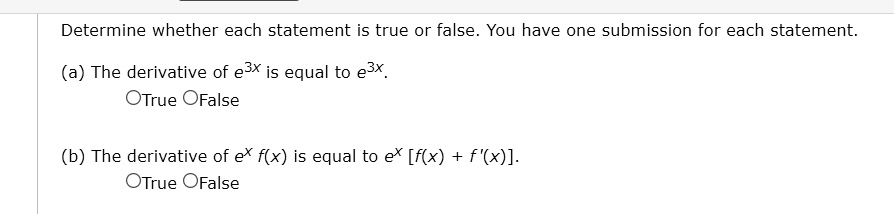
Determine whether each statement is true or false. You have one submission for each statement. (a) The derivative of
is equal to
. \OTrue \OFalse (b) The derivative of
is equal to
. \OTrue \OFalse
The Correct Answer and Explanation is:
Let’s analyze each part of the question in the image.
(a) The derivative of e3xe^{3x} is equal to e3xe^{3x}
Answer: False
Explanation:
To find the derivative of e3xe^{3x}, we must apply the chain rule from calculus. The chain rule tells us that if a function is composed of an outer function and an inner function, say f(g(x))f(g(x)), then the derivative is: ddxf(g(x))=f′(g(x))⋅g′(x)\frac{d}{dx}f(g(x)) = f'(g(x)) \cdot g'(x)
In this case:
- Outer function: eue^u
- Inner function: u=3xu = 3x
So, the derivative is: ddxe3x=e3x⋅ddx(3x)=e3x⋅3=3e3x\frac{d}{dx}e^{3x} = e^{3x} \cdot \frac{d}{dx}(3x) = e^{3x} \cdot 3 = 3e^{3x}
Therefore, ddx(e3x)≠e3x\frac{d}{dx}(e^{3x}) \neq e^{3x}, and the statement is False.
(b) The derivative of exf(x)e^x f(x) is equal to ex[f(x)+f′(x)]e^x[f(x) + f'(x)]
Answer: True
Explanation:
This expression requires the use of the product rule, which states: ddx(u⋅v)=u′v+uv′\frac{d}{dx}(u \cdot v) = u’v + uv’
Here:
- u=exu = e^x and u′=exu’ = e^x
- v=f(x)v = f(x) and v′=f′(x)v’ = f'(x)
Apply the product rule: ddx(exf(x))=ex⋅f(x)+ex⋅f′(x)\frac{d}{dx}(e^x f(x)) = e^x \cdot f(x) + e^x \cdot f'(x)
Factor out exe^x: =ex[f(x)+f′(x)]= e^x[f(x) + f'(x)]
So, the derivative is indeed ex[f(x)+f′(x)]e^x[f(x) + f'(x)], and the statement is True.
Summary:
- (a): False – because ddx(e3x)=3e3x\frac{d}{dx}(e^{3x}) = 3e^{3x}
- (b): True – due to correct application of the product rule
These questions test understanding of fundamental differentiation rules: the chain rule and the product rule, both essential in calculus.