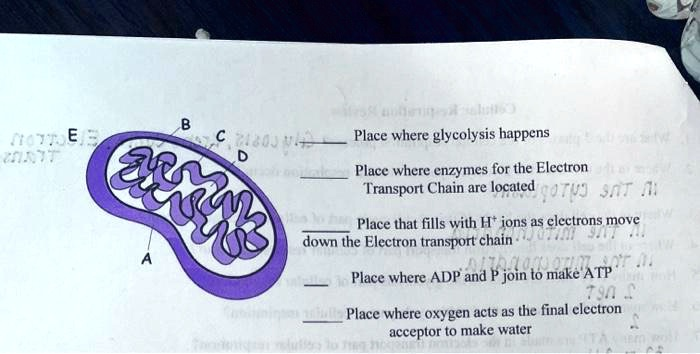
Place where glycolysis happens. Place where enzymes for the Electron Transport Chain are located. Isprvj Jo. Place that fills with H+ ions as electrons move down the Electron transport chain. Place where ADP and P join to make ATP. Place where oxygen acts as the final electron acceptor to make water.
The Correct Answer and Explanation is:
Correct Labeling of Mitochondrion Diagram:
- Place where glycolysis happens → E (Cytoplasm, outside the mitochondrion)
- Place where enzymes for the Electron Transport Chain are located → C (Inner mitochondrial membrane)
- Place that fills with H⁺ ions as electrons move down the Electron Transport Chain → B (Intermembrane space)
- Place where ADP and Pᵢ join to make ATP → D (Mitochondrial matrix)
- Place where oxygen acts as the final electron acceptor to make water → C (Inner mitochondrial membrane)
Explanation
The mitochondrion is often called the “powerhouse of the cell” due to its crucial role in cellular respiration and energy production. This organelle contains specialized structures that perform different parts of the aerobic respiration process.
Glycolysis, the first step of cellular respiration, takes place not inside the mitochondrion but in the cytoplasm (label E). During glycolysis, glucose is broken down into pyruvate, producing a small amount of ATP and NADH.
Once pyruvate enters the mitochondrion, the Electron Transport Chain (ETC) takes place in the inner mitochondrial membrane (label C). This membrane houses the protein complexes that shuttle electrons from NADH and FADH₂ to oxygen. As electrons move through the ETC, H⁺ ions are pumped into the intermembrane space (label B), creating a proton gradient.
The high concentration of H⁺ ions in the intermembrane space creates a chemiosmotic gradient. These protons then flow back into the mitochondrial matrix (label D) through ATP synthase, driving the phosphorylation of ADP to ATP. This process is known as oxidative phosphorylation.
Meanwhile, at the end of the ETC, oxygen acts as the final electron acceptor in the inner mitochondrial membrane (label C). It combines with electrons and protons to form water, a vital step to prevent electron buildup and allow the ETC to continue functioning.
This coordinated process of electron movement, proton pumping, and ATP synthesis ensures that cells efficiently produce the energy they need to survive.