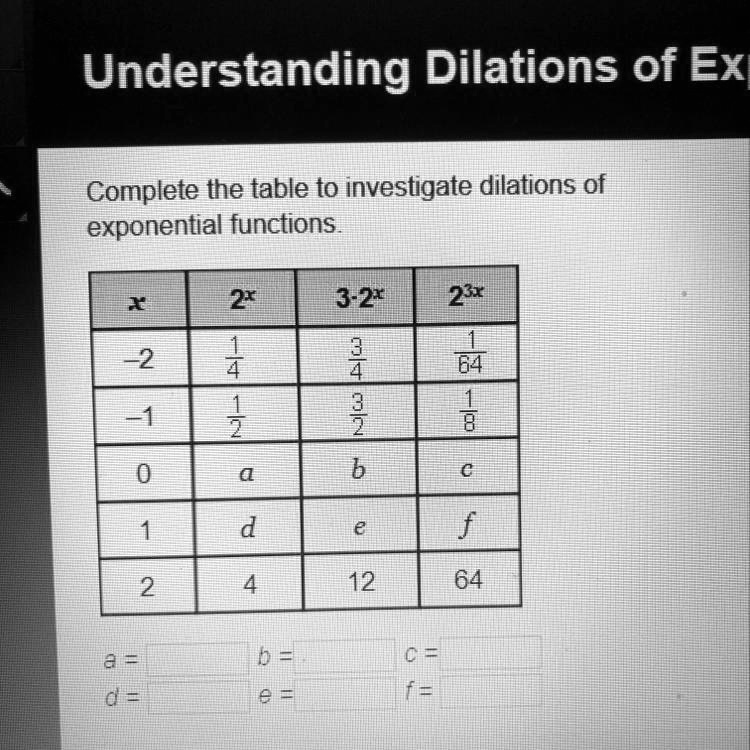
Understanding Dilations of Ex Complete the table to investigate dilations of exponential functions. x 2x 3\cdot2x 23x -2 1\ 4 3\ 4 1\ 64 -1 1\ 2 3\ 2 1\ 8 0 a b c 1 d e f 2 4 12 64 a = b = c = d = e = f =
The Correct Answer and Explanation is:
Completed Table:
Let’s evaluate each function for the missing values.
Given functions:
- 2×2^x2x
- 3⋅2×3 \cdot 2^x3⋅2x
- 23×2^{3x}23x
When x=0x = 0x=0:
- 20=1⇒a=12^0 = 1 \Rightarrow a = 120=1⇒a=1
- 3⋅20=3⋅1=3⇒b=33 \cdot 2^0 = 3 \cdot 1 = 3 \Rightarrow b = 33⋅20=3⋅1=3⇒b=3
- 23⋅0=20=1⇒c=12^{3 \cdot 0} = 2^0 = 1 \Rightarrow c = 123⋅0=20=1⇒c=1
When x=1x = 1x=1:
- 21=2⇒d=22^1 = 2 \Rightarrow d = 221=2⇒d=2
- 3⋅21=3⋅2=6⇒e=63 \cdot 2^1 = 3 \cdot 2 = 6 \Rightarrow e = 63⋅21=3⋅2=6⇒e=6
- 23⋅1=23=8⇒f=82^{3 \cdot 1} = 2^3 = 8 \Rightarrow f = 823⋅1=23=8⇒f=8
Final Answers:
- a=1a = 1a=1
- b=3b = 3b=3
- c=1c = 1c=1
- d=2d = 2d=2
- e=6e = 6e=6
- f=8f = 8f=8
Explanation
This table investigates how exponential functions change when dilated (stretched or compressed) in different ways. The three functions here—2×2^x2x, 3⋅2×3 \cdot 2^x3⋅2x, and 23×2^{3x}23x—each demonstrate a different kind of transformation of the base exponential function.
- 2×2^x2x is the base exponential function. As xxx increases, the output doubles with each step. For example, 2−2=142^{-2} = \frac{1}{4}2−2=41, 2−1=122^{-1} = \frac{1}{2}2−1=21, 20=12^0 = 120=1, 21=22^1 = 221=2, and 22=42^2 = 422=4.
- 3⋅2×3 \cdot 2^x3⋅2x represents a vertical dilation by a factor of 3. This means every value of 2×2^x2x is multiplied by 3. So, the shape of the graph stays the same, but all y-values are scaled three times higher.
- 23×2^{3x}23x shows a horizontal compression. The exponent 3x3x3x causes the function to grow much faster. For instance, at x=2x = 2x=2, instead of calculating 22=42^2 = 422=4, we compute 26=642^{6} = 6426=64. This means the graph of 23×2^{3x}23x increases more steeply, compressing it horizontally compared to 2×2^x2x.
In summary, these variations help students understand how exponential functions behave under dilations—whether stretching or compressing vertically or horizontally—shaping their graphs differently while preserving their general exponential nature.