Label the visual impairment and the lenses uses for correction. Concave corrective lens Corrected focal plane Hyperopia Convex corrective lens Myopia Corrected focal plane
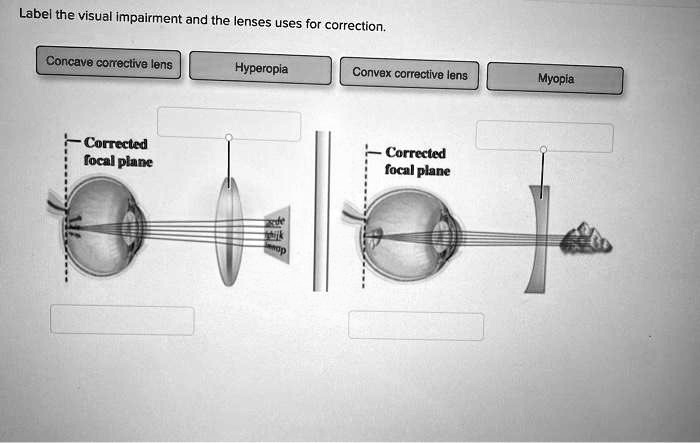
The Correct Answer and Explanation is:
Correct Labels:
Left Image:
- Top Box: Hyperopia
- Middle Box (Lens): Convex corrective lens
- Bottom Box: Corrected focal plane
Right Image:
- Top Box: Myopia
- Middle Box (Lens): Concave corrective lens
- Bottom Box: Corrected focal plane
Explanation :
This diagram illustrates two common refractive visual impairments—Hyperopia (farsightedness) and Myopia (nearsightedness)—along with the corrective lenses used to treat them.
Hyperopia (left image) occurs when the eye is too short or the cornea has too little curvature. As a result, light entering the eye focuses behind the retina, making it difficult to see nearby objects clearly. To correct this, a convex lens (also called a converging lens) is used. Convex lenses bend light rays inward before they enter the eye, so they converge directly on the retina rather than behind it, restoring clear near vision. This is why the corrected focal point in the diagram falls exactly on the retina when a convex lens is applied.
Myopia (right image) happens when the eyeball is too long or the cornea is overly curved, causing light rays to focus in front of the retina. This makes distant objects appear blurry. The correction involves using a concave lens (also known as a diverging lens). This type of lens spreads out light rays slightly so that after they enter the eye, they are brought to focus on the retina instead of in front of it. This correction allows for clear distance vision.
The labels on the diagram match these visual impairments and their respective corrective lenses. By properly labeling each type of vision error and identifying the correct lens type, one can understand how corrective eyewear functions to restore normal vision. The key distinction lies in where the uncorrected image focuses relative to the retina and how different lenses shift the focal point appropriately.