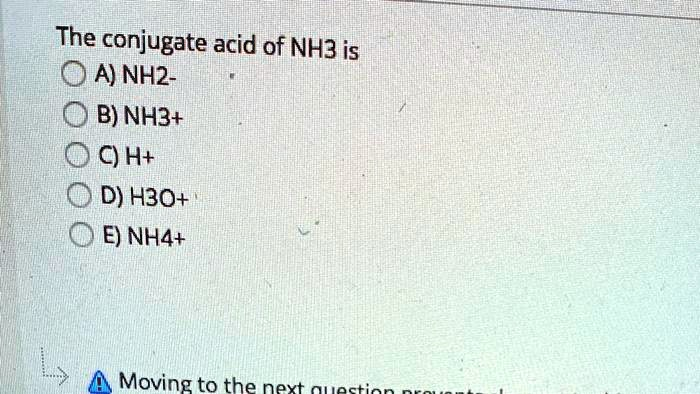
The conjugate acid of NH3 is NH3+.
The Correct Answer and Explanation is:
The correct answer is: E) NH4⁺
Explanation:
To understand conjugate acids and bases, we use the Brønsted–Lowry acid-base theory, which defines acids as proton (H⁺) donors and bases as proton acceptors.
Ammonia (NH₃) acts as a base because it has a lone pair of electrons on the nitrogen atom, which allows it to accept a proton (H⁺). When NH₃ accepts a proton, it becomes NH₄⁺ (ammonium ion). This is the conjugate acid of ammonia.
The reaction looks like this:NH3+H+→NH4+\text{NH}_3 + \text{H}^+ \rightarrow \text{NH}_4^+NH3+H+→NH4+
- In this reaction, NH₃ is the base, and after accepting H⁺, it becomes NH₄⁺, its conjugate acid.
Now, let’s consider the answer choices:
- A) NH₂⁻: This is the amide ion, a very strong base. It is not formed by NH₃ gaining a proton but by losing one (which makes it the conjugate base of NH₃, not its conjugate acid).
- B) NH₃⁺: This is not a valid species in aqueous chemistry. It’s not the correct conjugate acid.
- C) H⁺: A proton itself, not a conjugate acid of NH₃.
- D) H₃O⁺: This is the hydronium ion, formed when water gains a proton. It is unrelated to the conjugate acid of NH₃.
- E) NH₄⁺: This is correct, as explained above.
So, the conjugate acid of NH₃ is NH₄⁺, formed by the addition of a proton to the ammonia molecule.