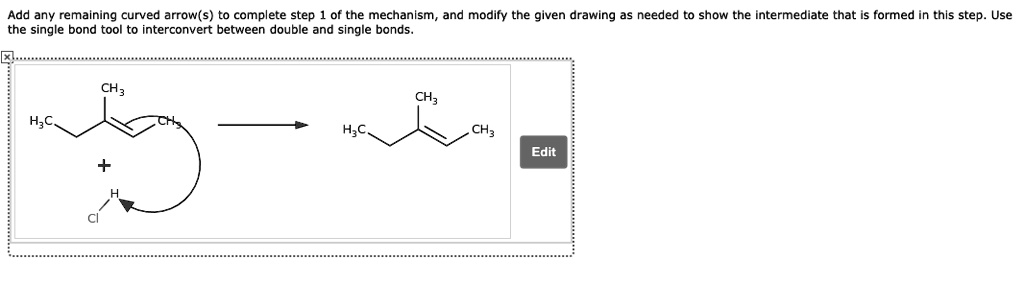
Add any remaining curved arrow(s) to complete step 1 of the mechanism, and modify the given drawing as needed to show the intermediate that is formed in this step. Use the single bond tool to interconvert between double and single bonds.
The Correct Answer and Explanation is:
To correctly complete step 1 of this electrophilic addition mechanism, we need to understand the reaction type and the behavior of the alkene in the presence of hydrogen chloride (HCl). The overall transformation here is the Markovnikov addition of HCl to an alkene.
Correct Mechanism and Curved Arrows:
- Curved Arrow from Double Bond to Hydrogen (H):
- One curved arrow should go from the π electrons of the double bond to the hydrogen atom of HCl. This shows that the double bond is acting as a nucleophile, attacking the hydrogen.
- Curved Arrow from H–Cl Bond to Cl:
- Another curved arrow should start at the H–Cl bond and point toward the Cl atom, indicating that Cl leaves as Cl⁻, a chloride anion, when the hydrogen is attacked.
Intermediate Structure:
After the alkene reacts with HCl, the following occurs:
- The proton (H⁺) adds to the less substituted carbon of the double bond, following Markovnikov’s rule. This leads to the more stable carbocation on the more substituted carbon.
- The result is a carbocation intermediate, which is stabilized due to the tertiary carbon center.
- The chloride ion (Cl⁻) remains nearby and will react in the next step (not shown here).
Thus, the final structure shown in this image already seems to depict the correct carbocation intermediate after protonation. The double bond has been replaced with a single bond, and the positive charge resides on the tertiary carbon.
Summary (Key Points):
- The π electrons of the alkene attack H⁺ from HCl.
- The H–Cl bond breaks heterolytically, giving Cl⁻.
- H⁺ adds to the less substituted carbon (anti-Markovnikov intermediate is not preferred).
- The more substituted carbon becomes a carbocation.
- Curved arrows must show electron flow from:
- The double bond to H,
- The H–Cl bond to Cl.
This step completes the first stage of the electrophilic addition reaction, forming a carbocation intermediate ready for nucleophilic attack.
