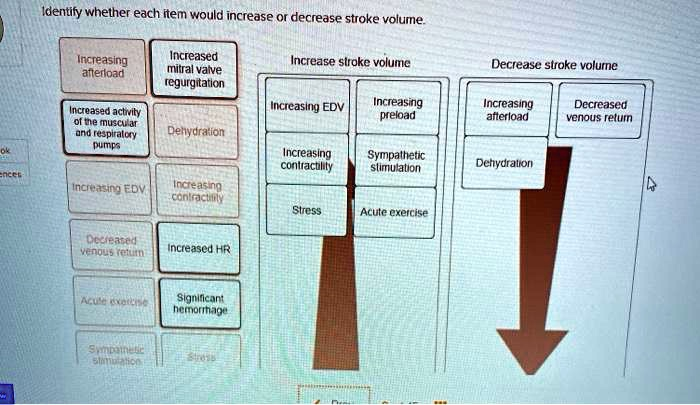
Identify whether each item would increase or decrease stroke volume. Increasing afterload Increased activity of the muscular and respiratory pumps Increased mitral valve regurgitation Increase stroke volume Decrease stroke volume Increasing EDV Increasing preload Increasing afterload Decreased venous return Dehydration Increasing contractility Sympathetic stimulation Dehydration Increasing EDV Increasing contractility Stress Acute exercise Decreased venous return Increased HR Acute exercise Significant hemorrhage Sympathetic stimulation Stress
The Correct Answer and Explanation is:
Correct Categorization:
Increase Stroke Volume:
- Increasing EDV (End-Diastolic Volume)
- Increasing preload
- Increasing contractility
- Sympathetic stimulation
- Acute exercise
- Stress
- Increased activity of the muscular and respiratory pumps
- Increased HR (Heart Rate)
Decrease Stroke Volume:
- Increasing afterload
- Decreased venous return
- Dehydration
- Significant hemorrhage
- Increased mitral valve regurgitation
Explanation
Stroke volume (SV) is the amount of blood ejected by the left ventricle of the heart with each beat. It is influenced by three primary factors: preload, afterload, and contractility.
- Preload refers to the degree of stretch of the cardiac muscle fibers at the end of diastole. An increase in preload, often due to increased EDV or enhanced venous return (like during acute exercise or increased respiratory pump activity), enhances stroke volume via the Frank-Starling mechanism.
- Contractility is the strength of the heart’s contraction independent of preload. Sympathetic stimulation and stress can both increase contractility, leading to a higher SV. Likewise, acute exercise stimulates the sympathetic nervous system, boosting both heart rate and contractility.
- Afterload is the resistance the left ventricle must overcome to circulate blood. An increase in afterload (e.g., due to hypertension or aortic stenosis) decreases stroke volume by making it more difficult for the heart to eject blood.
Decreased stroke volume can result from factors that reduce preload, such as dehydration, significant hemorrhage, or decreased venous return, all of which diminish the blood volume returning to the heart. Increased mitral valve regurgitation causes some blood to flow backward into the atrium during systole, effectively reducing the forward stroke volume.
On the other hand, increased heart rate (HR) can enhance venous return by shortening diastole to a point where the ventricle fills more efficiently, up to a certain point, thereby increasing stroke volume.
In summary, stroke volume is enhanced by anything that improves preload or contractility and is reduced by factors that increase afterload or reduce venous return.