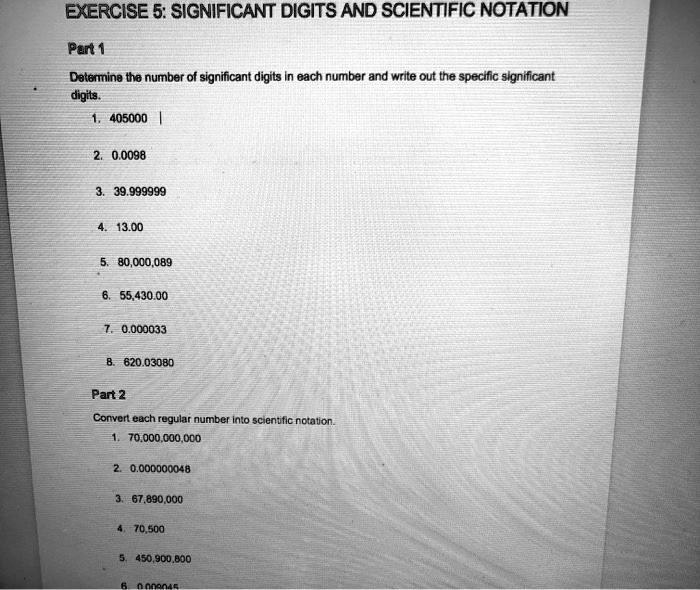
Significant Digits and Scientific Notation Part 1 Determine the number of significant digits in each number and write out the specific significant digits: 405,000 0.0098 39.999999 13.00 80,000,089 55,430.00 0.000033 620.03080 Part 2 Convert each regular number into scientific notation: 70,000,000 0.000000048 67,890,000 70,500 450,900,810
The Correct Answer and Explanation is:
Part 1: Significant Digits
Determine the number of significant digits and identify them:
- 405,000
- Significant digits: 3
- Digits: 4, 0, 5
(Trailing zeros are not significant unless there’s a decimal.)
- 0.0098
- Significant digits: 2
- Digits: 9, 8
(Leading zeros are not significant.)
- 39.999999
- Significant digits: 8
- Digits: 3, 9, 9, 9, 9, 9, 9, 9
- 13.00
- Significant digits: 4
- Digits: 1, 3, 0, 0
(Trailing zeros after decimal are significant.)
- 80,000,089
- Significant digits: 8
- Digits: 8, 0, 0, 0, 0, 0, 8, 9
- 55,430.00
- Significant digits: 7
- Digits: 5, 5, 4, 3, 0, 0, 0
- 0.000033
- Significant digits: 2
- Digits: 3, 3
- 620.03080
- Significant digits: 8
- Digits: 6, 2, 0, 0, 3, 0, 8, 0
Part 2: Scientific Notation
- 70,000,000,000 → 7.0 × 10¹⁰
- 0.000000048 → 4.8 × 10⁻⁸
- 67,890,000 → 6.789 × 10⁷
- 70,500 → 7.05 × 10⁴
- 450,900,800 → 4.509008 × 10⁸
- 0.000045 → 4.5 × 10⁻⁵
Explanation
Significant digits (or significant figures) are the digits in a number that carry meaningful information about its precision. They include all non-zero digits, any zeros between significant digits, and trailing zeros only if they are to the right of a decimal point. Leading zeros are never significant; they simply indicate the position of the decimal point.
For example, in 0.0098, the first two zeros are placeholders and not significant, so only “9” and “8” count. Meanwhile, a number like 13.00 includes the trailing zeros as significant because they reflect measured precision.
When dealing with large numbers like 405,000, trailing zeros without a decimal point are considered not significant unless otherwise specified. However, in 55,430.00, the decimal makes the trailing zeros significant because they show the number is measured to that precision.
Scientific notation is a method used to express very large or very small numbers in a compact form. It helps in simplifying calculations and clearly indicating significant digits. To convert a number into scientific notation, move the decimal point so that only one non-zero digit remains to the left of the decimal. The number of places you move the decimal becomes the exponent of 10.
For instance, 67,890,000 becomes 6.789 × 10⁷ because the decimal moves 7 places to the left. For small numbers like 0.000000048, you move the decimal 8 places to the right, so it becomes 4.8 × 10⁻⁸.
Understanding significant digits and scientific notation is essential in science and engineering because they reflect the precision of measurements and help manage very large or small quantities efficiently.
