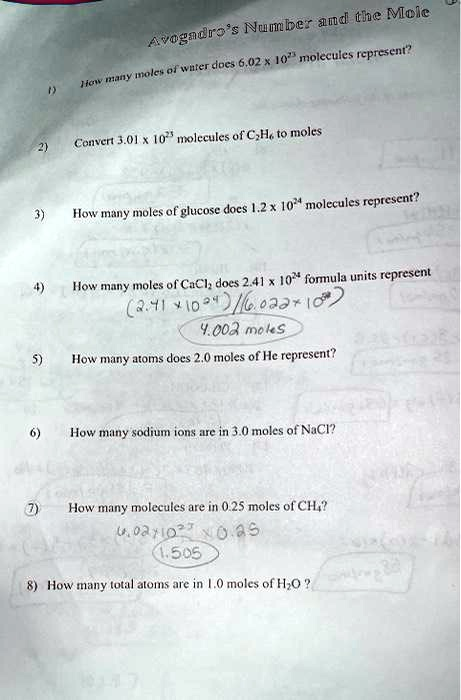
Avogadro’s Number and the Mole 1) How many moles of water does 6.02 x 10^23
molecules represent? 2) Convert 3.01 x 10
molecules of C
H
to moles 3) How many moles of glucose does 1.2 x 10
molecules represent? 4) How many moles of CaCl
does 2.41 x 10
formula units represent 5) How many atoms does 2.0 moles of He represent? 6) How many sodium ions are in 3.0 moles of NaCl? 7) How many molecules are in 0.25 moles of CH
? 8) How many total atoms are in 1.0 moles of H
O?
The Correct Answer and Explanation is:
Answers
- How many moles of water does 6.02×10236.02 \times 10^{23}6.02×10²³ molecules represent?
Moles=6.02×10236.022×1023=1.00 mol\text{Moles} = \frac{6.02 \times 10^{23}}{6.022 \times 10^{23}} = 1.00 \text{ mol}Moles=6.022×10236.02×1023=1.00 mol
- Convert 3.01×10233.01 \times 10^{23}3.01×10²³ molecules of C2H6C_2H_6C2H6 to moles
Moles=3.01×10236.022×1023≈0.500 mol\text{Moles} = \frac{3.01 \times 10^{23}}{6.022 \times 10^{23}} \approx 0.500 \text{ mol}Moles=6.022×10233.01×1023≈0.500 mol
- How many moles of glucose does 1.2×10241.2 \times 10^{24}1.2×1024 molecules represent?
Moles=1.2×10246.022×1023≈1.993 mol\text{Moles} = \frac{1.2 \times 10^{24}}{6.022 \times 10^{23}} \approx 1.993 \text{ mol}Moles=6.022×10231.2×1024≈1.993 mol
- How many moles of CaCl2CaCl_2CaCl2 does 2.41×10242.41 \times 10^{24}2.41×1024 formula units represent?
Moles=2.41×10246.022×1023≈4.002 mol(Correct in image)\text{Moles} = \frac{2.41 \times 10^{24}}{6.022 \times 10^{23}} \approx 4.002 \text{ mol} \quad \text{(Correct in image)}Moles=6.022×10232.41×1024≈4.002 mol(Correct in image)
- How many atoms does 2.0 moles of He represent?
Atoms=2.0×6.022×1023=1.204×1024 atoms\text{Atoms} = 2.0 \times 6.022 \times 10^{23} = 1.204 \times 10^{24} \text{ atoms}Atoms=2.0×6.022×1023=1.204×1024 atoms
- How many sodium ions are in 3.0 moles of NaCl?
Each NaCl formula unit gives 1 Na⁺ ion: Na⁺ ions=3.0×6.022×1023=1.807×1024\text{Na⁺ ions} = 3.0 \times 6.022 \times 10^{23} = 1.807 \times 10^{24}Na⁺ ions=3.0×6.022×1023=1.807×1024
- How many molecules are in 0.25 moles of CH4CH_4CH4?
Molecules=0.25×6.022×1023=1.506×10²³\text{Molecules} = 0.25 \times 6.022 \times 10^{23} = 1.506 \times 10^{23}Molecules=0.25×6.022×1023=1.506×10²³
- How many total atoms are in 1.0 mole of H2OH_2OH2O?
Each molecule of water contains 3 atoms (2 H and 1 O): 1.0×6.022×1023 molecules×3=1.807×1024 atoms1.0 \times 6.022 \times 10^{23} \text{ molecules} \times 3 = 1.807 \times 10^{24} \text{ atoms}1.0×6.022×1023 molecules×3=1.807×1024 atoms
Explanation
In chemistry, Avogadro’s number (6.022×10236.022 \times 10^{23}6.022×10²³) represents the number of particles in one mole of a substance, whether atoms, molecules, or formula units. This constant enables conversions between the microscopic scale (particles) and macroscopic scale (moles and grams), which is essential in stoichiometry and chemical calculations.
To find moles from particles, we divide the number of particles by Avogadro’s number. For example, if you have 1.2×10241.2 \times 10^{24}1.2×1024 molecules of glucose, dividing by 6.022×10236.022 \times 10^{23}6.022×10²³ gives approximately 1.993 moles. Conversely, to find particles from moles, we multiply. For instance, 0.25 moles of methane contains 0.25×6.022×10230.25 \times 6.022 \times 10^{23}0.25×6.022×1023, or about 1.506×10231.506 \times 10^{23}1.506×10²³ molecules.
Certain compounds require further interpretation. For example, 1 mole of H2OH_2OH2O contains 3 atoms per molecule (2 hydrogen and 1 oxygen), so 1 mole of water contains 3×6.022×10233 \times 6.022 \times 10^{23}3×6.022×1023 atoms in total. Similarly, ionic compounds like NaClNaClNaCl dissociate in water, producing separate sodium and chloride ions; thus, 1 mole of NaCl yields 1 mole of Na⁺ ions and 1 mole of Cl⁻ ions.
Understanding these concepts helps in tasks like determining reactant quantities, predicting products, and interpreting laboratory data. Mastery of mole-particle conversions is a cornerstone in general chemistry.
