Cool Down: Lin’s job pays$8.25 an hour plus $10 of transportation
10 of transportation allowance each week. She has to work at least 5 hours a week to keep the job, and can earn up to $175 per week (including the allowance). 1. Represent this situation mathematically. If you use variables, specify what each one means
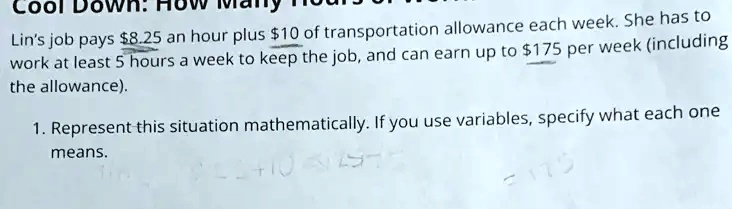
The Correct Answer and Explanation is:
Mathematical Representation
Let:
- hhh = number of hours Lin works per week
- Lin earns $8.25 per hour
- She receives a $10 transportation allowance weekly
- Total weekly earnings must be no more than $175
- Lin must work at least 5 hours per week
We can express the situation with the following inequality:8.25h+10≤175andh≥58.25h + 10 \leq 175 \quad \text{and} \quad h \geq 58.25h+10≤175andh≥5
Explanation
This problem describes a real-life situation that involves a job with hourly pay, a fixed allowance, and constraints on weekly income and hours worked. To understand and model this mathematically, we begin by defining a variable: let hhh represent the number of hours Lin works each week.
Lin earns $8.25 for each hour she works. So, her pay from hourly work is 8.25h8.25h8.25h. In addition to her hourly wage, she gets a $10 transportation allowance every week, regardless of the number of hours she works. Therefore, her total weekly earnings can be expressed as:Total weekly pay=8.25h+10\text{Total weekly pay} = 8.25h + 10Total weekly pay=8.25h+10
However, there are two important conditions:
- She must work at least 5 hours per week: This means h≥5h \geq 5h≥5.
- She can earn up to $175 per week (including the $10 allowance): This means her total earnings cannot exceed $175, so we write 8.25h+10≤1758.25h + 10 \leq 1758.25h+10≤175.
To represent the complete situation, we combine these two conditions into a system of inequalities:{8.25h+10≤175h≥5\begin{cases} 8.25h + 10 \leq 175 \\ h \geq 5 \end{cases}{8.25h+10≤175h≥5
This mathematical representation allows us to explore how many hours Lin can work while staying within the limits of her job. For example, solving the first inequality would help find the maximum number of hours she can work without going over the $175 limit. These kinds of expressions are essential in real-life budgeting and job planning, especially when dealing with part-time work or earnings with limits.
