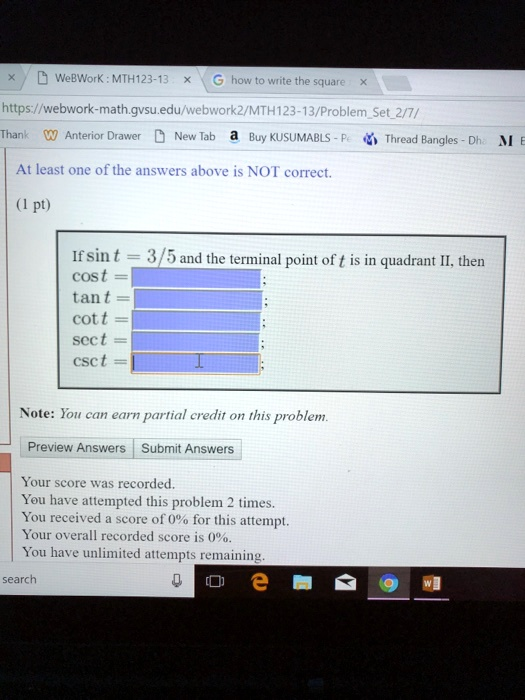
If \sin t = 3/5 and the terminal point of
is in quadrant II, then \cos t = \tan t = \cot t = \sec t = \csc t =
The Correct Answer and Explanation is:
Given:
sint=35\sin t = \dfrac{3}{5}sint=53, and the terminal point of ttt is in Quadrant II.
Step 1: Use the Pythagorean identity to find cost\cos tcost
The identity is:sin2t+cos2t=1\sin^2 t + \cos^2 t = 1sin2t+cos2t=1
Substitute sint=35\sin t = \dfrac{3}{5}sint=53:(35)2+cos2t=1925+cos2t=1cos2t=1−925=1625\left(\dfrac{3}{5}\right)^2 + \cos^2 t = 1 \\ \dfrac{9}{25} + \cos^2 t = 1 \\ \cos^2 t = 1 – \dfrac{9}{25} = \dfrac{16}{25}(53)2+cos2t=1259+cos2t=1cos2t=1−259=2516
So,cost=±45\cos t = \pm \dfrac{4}{5}cost=±54
But since the angle is in Quadrant II, and cosine is negative in Quadrant II:cost=−45\cos t = -\dfrac{4}{5}cost=−54
Step 2: Find the remaining trig functions
Now that we have:
- sint=35\sin t = \dfrac{3}{5}sint=53
- cost=−45\cos t = -\dfrac{4}{5}cost=−54
We can compute:
- tant=sintcost\tan t = \dfrac{\sin t}{\cos t}tant=costsint tant=3/5−4/5=−34\tan t = \dfrac{3/5}{-4/5} = -\dfrac{3}{4}tant=−4/53/5=−43
- cott=1tant=1−3/4=−43\cot t = \dfrac{1}{\tan t} = \dfrac{1}{-3/4} = -\dfrac{4}{3}cott=tant1=−3/41=−34
- sect=1cost=1−4/5=−54\sec t = \dfrac{1}{\cos t} = \dfrac{1}{-4/5} = -\dfrac{5}{4}sect=cost1=−4/51=−45
- csct=1sint=13/5=53\csc t = \dfrac{1}{\sin t} = \dfrac{1}{3/5} = \dfrac{5}{3}csct=sint1=3/51=35
Final Answers:
- sint=35\sin t = \dfrac{3}{5}sint=53
- cost=−45\cos t = -\dfrac{4}{5}cost=−54
- tant=−34\tan t = -\dfrac{3}{4}tant=−43
- cott=−43\cot t = -\dfrac{4}{3}cott=−34
- sect=−54\sec t = -\dfrac{5}{4}sect=−45
- csct=53\csc t = \dfrac{5}{3}csct=35
Explanation
To solve this trigonometric problem, we start with the given value of sint=35\sin t = \dfrac{3}{5}sint=53, meaning the opposite side of a right triangle is 3 and the hypotenuse is 5. We need to find all other trigonometric functions based on this.
Using the Pythagorean identity, sin2t+cos2t=1\sin^2 t + \cos^2 t = 1sin2t+cos2t=1, we can find cost\cos tcost. Substituting sint=35\sin t = \dfrac{3}{5}sint=53, we calculate:cos2t=1−(35)2=1−925=1625\cos^2 t = 1 – \left(\dfrac{3}{5}\right)^2 = 1 – \dfrac{9}{25} = \dfrac{16}{25}cos2t=1−(53)2=1−259=2516
Taking the square root gives cost=±45\cos t = \pm \dfrac{4}{5}cost=±54. However, the quadrant of the angle matters. In Quadrant II, sine is positive but cosine is negative. So, cost=−45\cos t = -\dfrac{4}{5}cost=−54.
Now that both sine and cosine are known, we can derive the remaining trigonometric functions:
- tant=sintcost=3/5−4/5=−34\tan t = \dfrac{\sin t}{\cos t} = \dfrac{3/5}{-4/5} = -\dfrac{3}{4}tant=costsint=−4/53/5=−43
- cott=1tant=−43\cot t = \dfrac{1}{\tan t} = -\dfrac{4}{3}cott=tant1=−34
- sect=1cost=−54\sec t = \dfrac{1}{\cos t} = -\dfrac{5}{4}sect=cost1=−45
- csct=1sint=53\csc t = \dfrac{1}{\sin t} = \dfrac{5}{3}csct=sint1=35
Understanding quadrant signs is crucial: in Quadrant II, only sine and cosecant are positive. The other functions are negative due to the signs of x and y coordinates in that quadrant.
