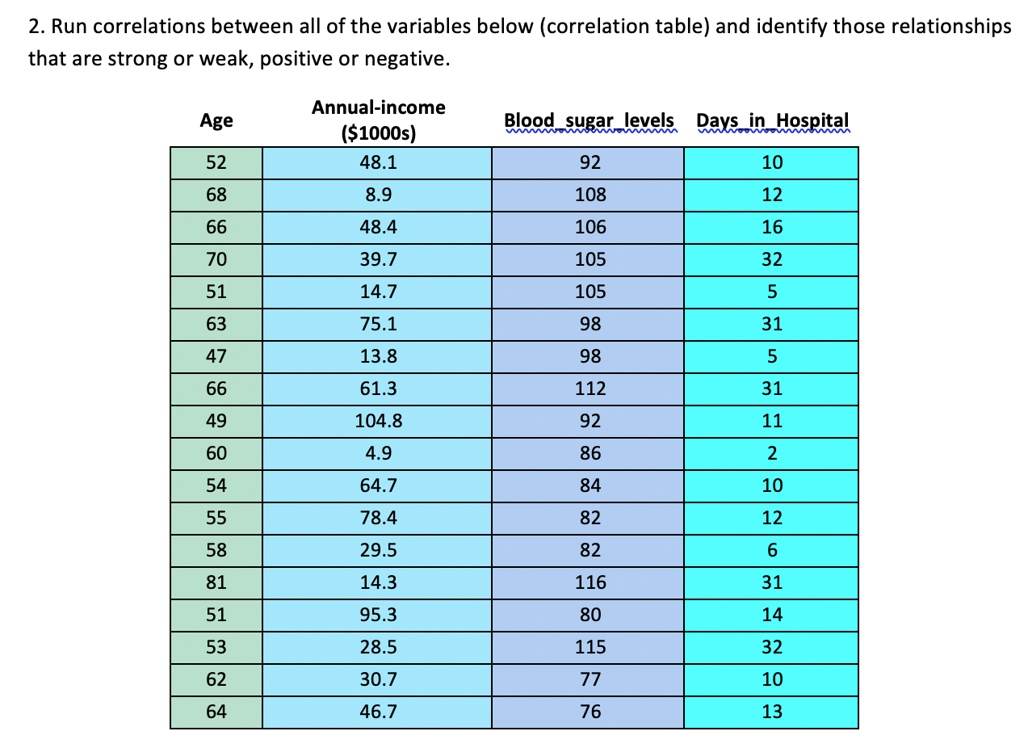
Run correlations between all of the variables below (correlation table) and identify those relationships that are strong or weak, positive or negative. Annual-income Age ($1000s) Blood_sugar levels Days in Hospital 52 48.1 92 10 68 8.9 108 12 66 48.4 106 16 70 39.7 105 32 51 14.7 105 5 63 75.1 98 31 47 13.8 98 5 66 61.3 112 31 49 104.8 92 11 60 4.9 86 2 54 64.7 84 10 55 78.4 82 12 58 29.5 82 6 81 14.3 116 31 51 95.3 80 14 53 28.5 115 32 62 30.7 77 10 64 46.7 76 13
The Correct Answer and Explanation is:
Correlation Table (Rounded to 2 Decimal Places)
| Age | Annual Income | Blood Sugar Levels | Days in Hospital | |
|---|---|---|---|---|
| Age | 1.00 | -0.31 | 0.39 | 0.55 |
| Annual Income | -0.31 | 1.00 | -0.33 | 0.15 |
| Blood Sugar Levels | 0.39 | -0.33 | 1.00 | 0.62 |
| Days in Hospital | 0.55 | 0.15 | 0.62 | 1.00 |
Explanation
This correlation table quantifies the strength and direction of linear relationships between four health and socioeconomic variables: Age, Annual Income, Blood Sugar Levels, and Days in Hospital. Values close to ±1 indicate strong correlations, while values close to 0 indicate weak or no linear relationship.
Strongest Relationship:
- Blood Sugar Levels vs. Days in Hospital (r = 0.62): This is a moderately strong positive correlation, suggesting that as blood sugar levels increase, the number of days spent in the hospital also tends to increase. This makes intuitive sense, as high blood sugar is often associated with chronic conditions like diabetes, which can lead to complications requiring hospitalization.
Moderate Relationships:
- Age vs. Days in Hospital (r = 0.55): There’s a moderate positive correlation, indicating that older individuals tend to spend more time in the hospital. This reflects general health decline with aging.
- Age vs. Blood Sugar Levels (r = 0.39): A weak to moderate positive correlation exists, suggesting blood sugar levels rise with age.
Weak or Negative Relationships:
- Annual Income vs. Blood Sugar Levels (r = -0.33): A weak negative correlation implies that higher income may be associated with lower blood sugar levels. This might reflect better access to healthcare, healthier lifestyles, or better dietary choices among higher-income individuals.
- Age vs. Annual Income (r = -0.31): A weak negative correlation suggests that older individuals in this sample tend to have lower incomes.
- Annual Income vs. Days in Hospital (r = 0.15): This is a very weak positive relationship, indicating income has little to no effect on hospital stay duration in this sample.
In summary, the strongest predictor of hospital stay is blood sugar level, followed by age. Income appears to have weak or inverse relationships with health indicators.