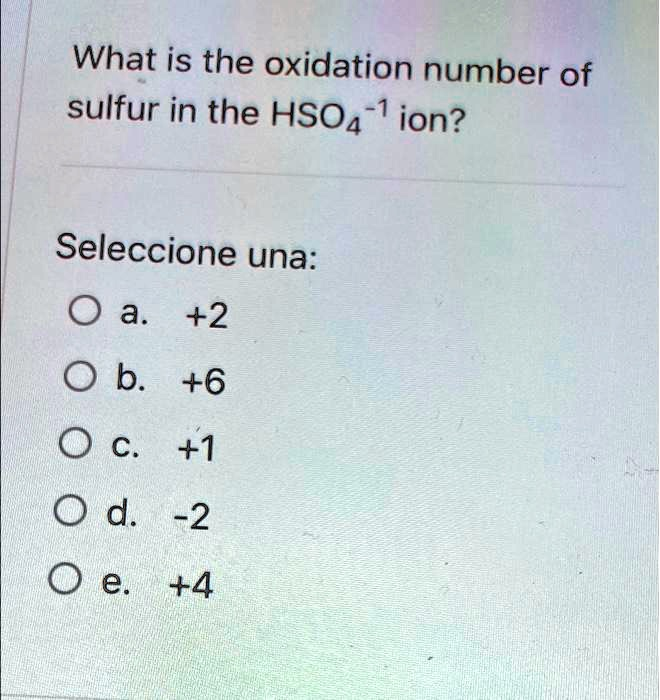
What is the oxidation number of sulfur in the
ion? Seleccione una:
a. +2
b. +6
c. +1
d. -2
e. +4
Correct Answer: b. +6
Explanation:
To determine the oxidation number of an element within a polyatomic ion, we use a set of established rules. The core principle is that the sum of the oxidation numbers of all the atoms in an ion must be equal to the overall charge of the ion.
The ion in question is the bisulfate ion, HSO₄⁻¹.
- Identify the overall charge of the ion.
The superscript “-1” indicates that the overall charge of the HSO₄⁻¹ ion is -1. - Assign oxidation numbers to the known elements.
According to standard chemical rules:- The oxidation number of hydrogen (H) is typically +1 when it is bonded to nonmetals.
- The oxidation number of oxygen (O) is almost always -2 in compounds, except in peroxides or when bonded to a more electronegative element like fluorine. In HSO₄⁻¹, its oxidation number is -2.
- Set up an algebraic equation.
Let the unknown oxidation number of sulfur (S) be ‘x’. The ion contains one hydrogen atom, one sulfur atom, and four oxygen atoms. We can write an equation summing the oxidation numbers to equal the total charge of the ion:(Number of H atoms × Oxidation # of H) + (Number of S atoms × Oxidation # of S) + (Number of O atoms × Oxidation # of O) = Total ChargeSubstituting the values:
(1 × +1) + (1 × x) + (4 × -2) = -1 - Solve the equation for x.
+1 + x – 8 = -1
x – 7 = -1
x = -1 + 7
x = +6
Therefore, the oxidation number of sulfur (S) in the HSO₄⁻¹ ion is +6.
